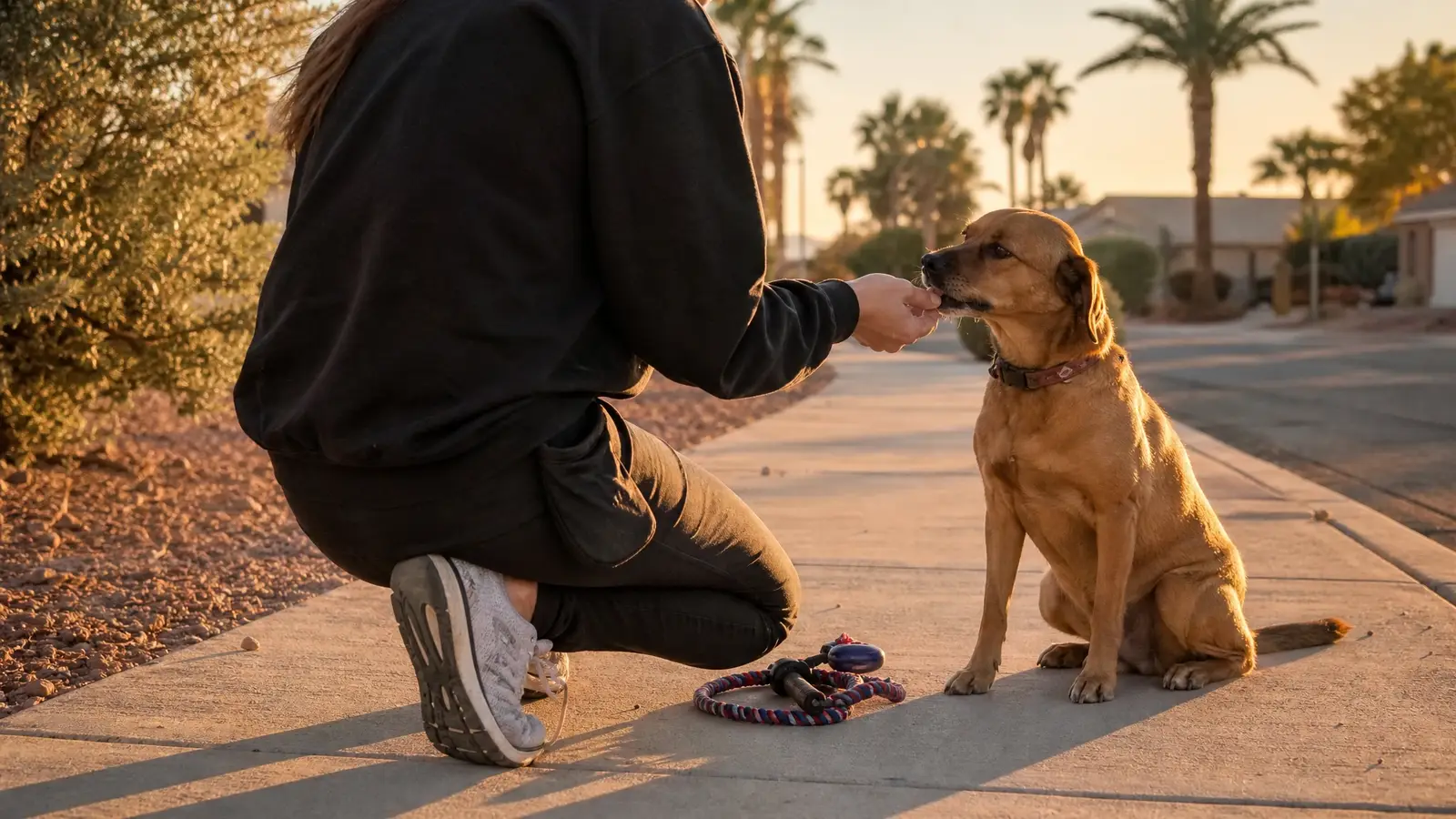
We are dog trainers who coach owners in North Las Vegas in person and online, with reward-based methods and humane tools only. This page covers our standards, how to start and the local rules we plan around, last verified 2026-11-17.
Tell us about your dog and we will explain how we would start
- In-person training in North Las Vegas and nearby areas
- Online training anywhere
- Reward-based methods only
Who are we, and what do we do?
We are dog trainers who coach owners, in person in North Las Vegas and online, using reward-based methods and humane tools only. We teach the dog, but we spend as much time teaching you, because the daily routine at your house is where behavior changes.
This page sets out our standards in plain terms. It makes no claims about awards, client numbers or success rates, because we would rather you judge us by the plan, the methods and the answers to your questions. Local facts on this page were last verified on 2026-11-17.
What standards do we hold ourselves to?
Our standards are simple and we apply them to every dog, puppy or adult, easy or hard.
- Reward what we want. Food, play and praise mark the behavior we are building.
- Prevent rehearsal of the problem. Gates, leashes, distance and routines keep the unwanted habit from paying off while new skills grow.
- Go slowly with fear. Gradual desensitization and counter-conditioning start below the point where your dog gets upset.
- Keep sessions short. A few minutes, repeated often, beats long drills.
- Coach the owner. You get a clear plan, a short practice routine and help adjusting it.
- Use humane tools only. No pain, fear or intimidation. Veterinary behavior bodies such as AVSAB and AAHA advise against aversive methods (AVSAB humane training statement, hosted by Purdue).
- Be honest about limits. We do not guarantee results, and we say so when a problem needs a vet or a veterinary behaviorist.
How do you get started with us?
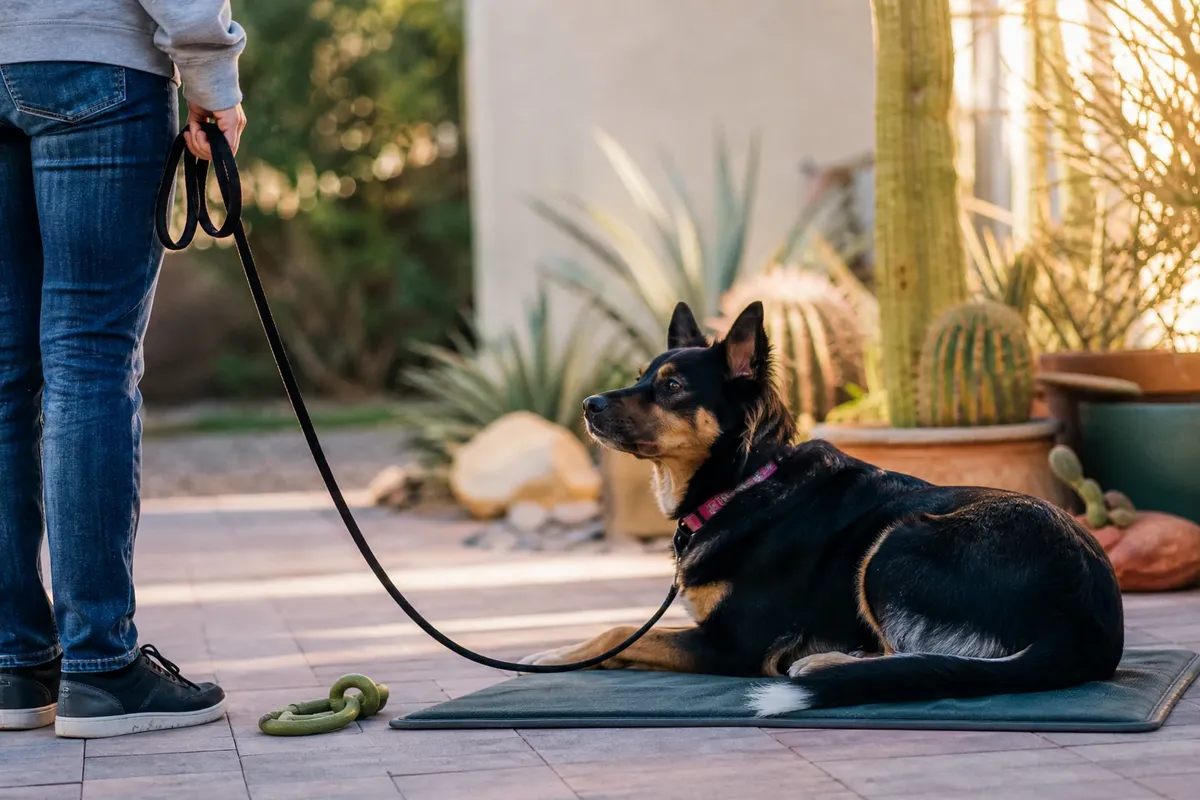
Choose in-person or online, and tell us about your dog, including any bite history or safety concern, so a trainer can plan carefully. That is all you need to begin. There is no long onboarding: we ask what your dog does, when it happens and what you have tried, then explain which program fits.
- In-person: we work at your home and on your usual routes. See private in-home training.
- Online: live video coaching with a written plan. See online dog training.
- Not sure: read types of training compared or go straight to choose in-person or online.
After that first conversation, our first sessions focus on the one or two behaviors that matter most to your household, so you see practical change rather than a long list of cues.
How does North Las Vegas shape our plans?
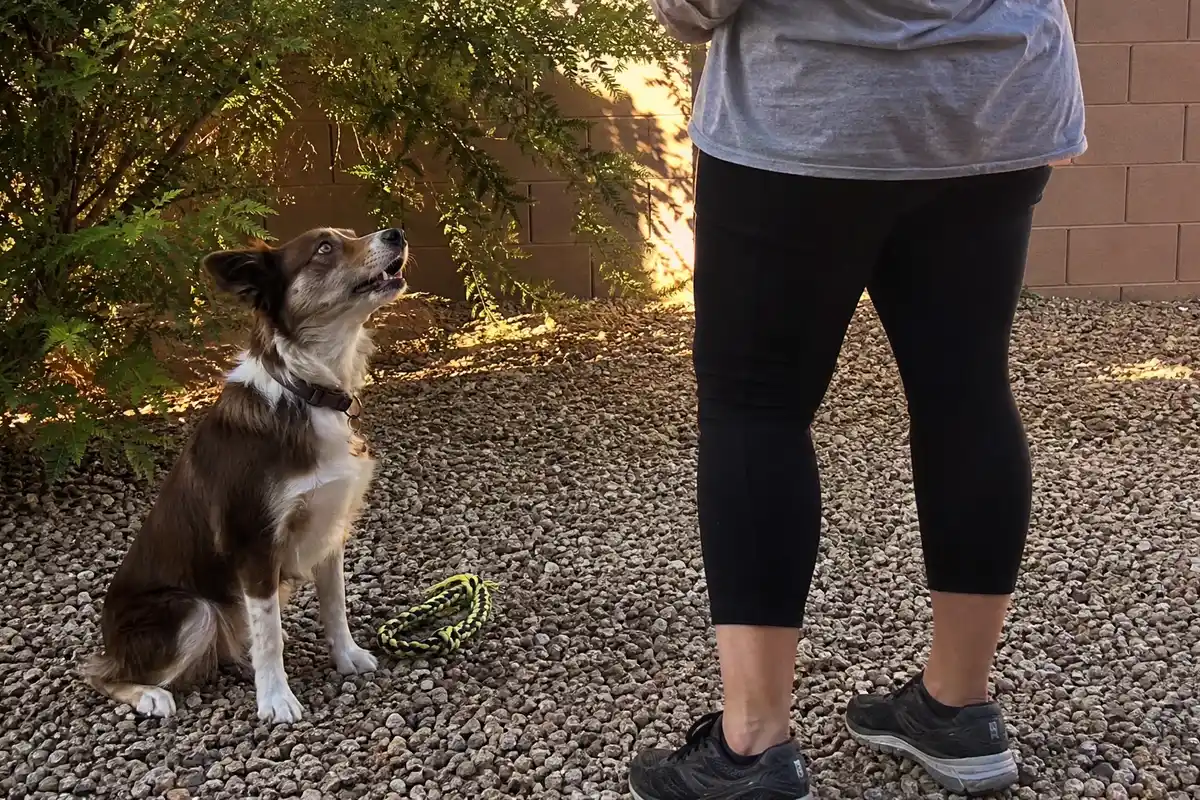
We tailor each plan to the place you live and the weather you live in. In North Las Vegas that means heat first. Clark County says hot pavement can burn paw pads and advises walks in the early morning or late evening (Clark County heat release), so we schedule outdoor work for cooler hours and keep indoor games ready. We also plan around the places owners actually use. The city runs Craig Ranch Regional Park with three dog parks open daily 6 a.m. to 11 p.m., and its parks page says dogs must be leashed outside designated areas and kept off sports fields, courts, skate parks and play areas.
Citywide, the Animal Protection page says all pets must be leashed unless confined on the owner's property, with fines up to $1,137 per offense, and the Pet Licenses page says dogs and cats need a city license and current rabies certificate. We treat those as the baseline for every outing and remind owners about them, but we do not give legal advice. Check with the city.
A common situation North Las Vegas owners face is a dog that is calm in the house but frantic on the evening walk, when other dogs, joggers and a warm sidewalk all arrive at once. We reduce each piece, rehearse it at a distance and reward calm choices before we ask for more.
What happens in the first sessions, and what does daily practice look like?
The first sessions follow a sequence. We start by understanding the problem and your goals. We then give you one or two simple exercises, usually a settle on a mat, name response or loose-leash start, and we watch you practice so we can adjust timing. After that we add difficulty slowly: more distance covered, more distractions, longer duration.
How long it takes depends on your dog and on how consistently you practice. We check progress against small markers, such as how quickly your dog looks back at you, rather than promising a deadline. If we are not seeing change, we tell you and adjust the plan or suggest your vet.
Our first 30 days plan lays out what a typical month can look like.
Expect a small amount of practice every day. Most of our plans ask for two to four short sessions of three to five minutes, tied to things you already do: before meals, at the door, on the way out for a walk. Short and frequent is easier to keep up and easier for your dog to learn from.
- Morning: a short skill session before breakfast, indoors, when the day is coolest.
- Midday: a mat or crate rest with a chew, so your dog learns that quiet is rewarded.
- Evening: a leash skills session when pavement has cooled enough for your hand, then a decompression sniff walk.
- Anytime: reward calm behavior you did not ask for, such as lying down while guests talk.
Tell us what your week really looks like, including work hours, travel and who else lives in the home. We would rather build a plan that matches a shift schedule, a rental with a shared hallway or a household with children is more likely to stick than hand you a perfect plan you cannot follow, so please be frank with us.
What do we refer, and what does the law say?
We offer behavior help for common issues, and we refer when a case is beyond a pet trainer's role. Dogs with sudden behavior changes, pain, or severe aggression should see a vet first. Any dog with a bite history should be managed carefully until a plan is in place.
State and city law set boundaries we respect. Nevada state law (NRS 202.500) says a dog may not be found dangerous or vicious based solely on its breed (Nevada statute chapter 202). The city publishes no dangerous-dog text we could open, so we point owners to the city's code and Animal Protection Services for city rules. Nevada state law (NRS 574.100) also limits tethering: no more than 10 hours in a 24-hour period, and not with a tether under 12 feet long (Nevada statute chapter 574); this is state law, not a confirmed city rule.
How do we train?
Our approach is the same for every dog: rewards for what we want, management so mistakes get fewer chances, gradual desensitization and counter-conditioning for fear, short consistent sessions and coaching for the owner. We use humane tools only.
In North Las Vegas that includes planning walks and practice for the cooler hours, and we promise no timeline, because progress depends on the dog and on your consistency.
Frequently asked questions
Who are we?
We are the trainers who coach you and your dog, in person in North Las Vegas or online. We make no claims about awards, client counts or success rates; our standards are the ones on this page.
What methods do you use?
Reward-based teaching, management and prevention, gradual desensitization and counter-conditioning, short consistent sessions and owner coaching, with humane tools only.
How do I get started?
Choose in-person or online and tell us about your dog, including any bite history or safety concern. A trainer then explains which program fits.
Do you guarantee results?
No. Progress depends on your dog and on how consistently you practice. We set small markers and adjust the plan as we go.
Do you handle aggression?
We work with many fear and reactivity cases, with careful management. Serious aggression often needs your vet or a veterinary behaviorist too, so tell us at the start.
Keep reading
- Choose in-person or onlineRead more →
- private in-home trainingRead more →
- online dog trainingRead more →
- methods and red flagsRead more →
- first 30 days planRead more →
- types of dog training comparedRead more →
Sources
- Purdue Canine Welfare Science Center, AVSAB humane dog training position statement (last verified 2026-11-17)
- AAHA, 2015 Canine and Feline Behavior Management Guidelines, take-home messages (last verified 2026-11-17)
- Clark County, pet heat safety news release (last verified 2026-11-17)
- City of North Las Vegas, Craig Ranch Regional Park (last verified 2026-11-17)
- City of North Las Vegas, Parks page (park rules) (last verified 2026-11-17)
- City of North Las Vegas, Animal Protection Services page (last verified 2026-11-17)
- City of North Las Vegas, Pet Licenses page (last verified 2026-11-17)
- Nevada Revised Statutes chapter 202 (NRS 202.500, state law) (last verified 2026-11-17)
- Nevada Revised Statutes chapter 574 (NRS 574.100, state law) (last verified 2026-11-17)
Tell us about your dog and we will explain how we would start
- In-person training in North Las Vegas and nearby areas
- Online training anywhere
- Reward-based methods only