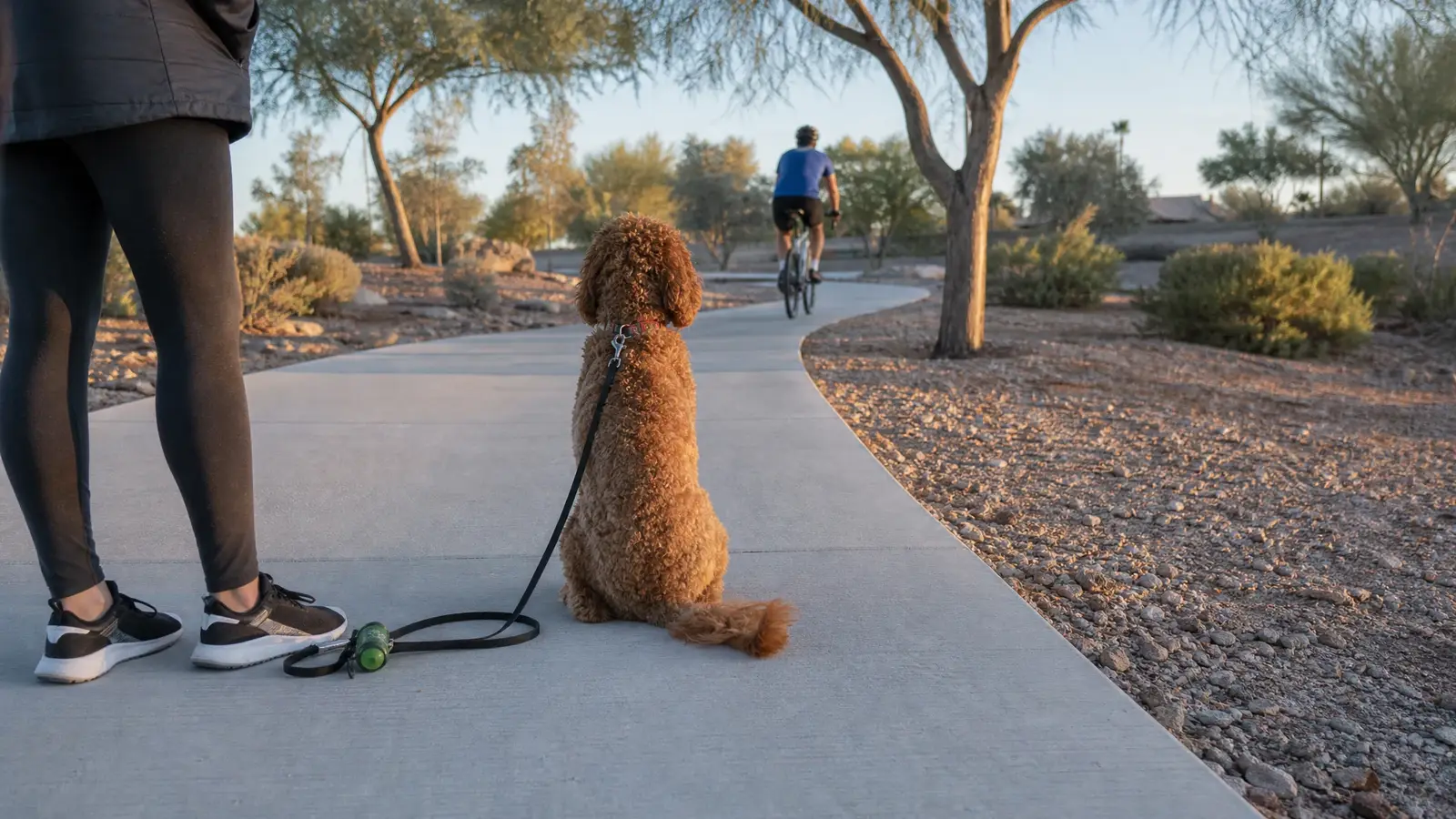
Advanced obedience takes skills your dog already knows and makes them hold up around distractions: other dogs, joggers, the doorbell, a gate that opens onto a street. We do it by raising difficulty gradually and paying well for success. Local details here were last verified 2026-11-17.
Basics are solid but real life still breaks them? Tell us where your dog slips and what distracts him.
- In-person training in North Las Vegas and nearby areas
- Online training anywhere
- Reward-based methods only
What makes obedience advanced?
Advanced work is about reliability, not new tricks. A dog that sits perfectly in the kitchen but ignores you at the park is not yet reliable, and the gap is distraction, distance and duration. We train those three on purpose.
| Variable | What we change | Example |
|---|---|---|
| Distraction | Add movement, noise, other dogs | Stay while a bike goes by at a distance |
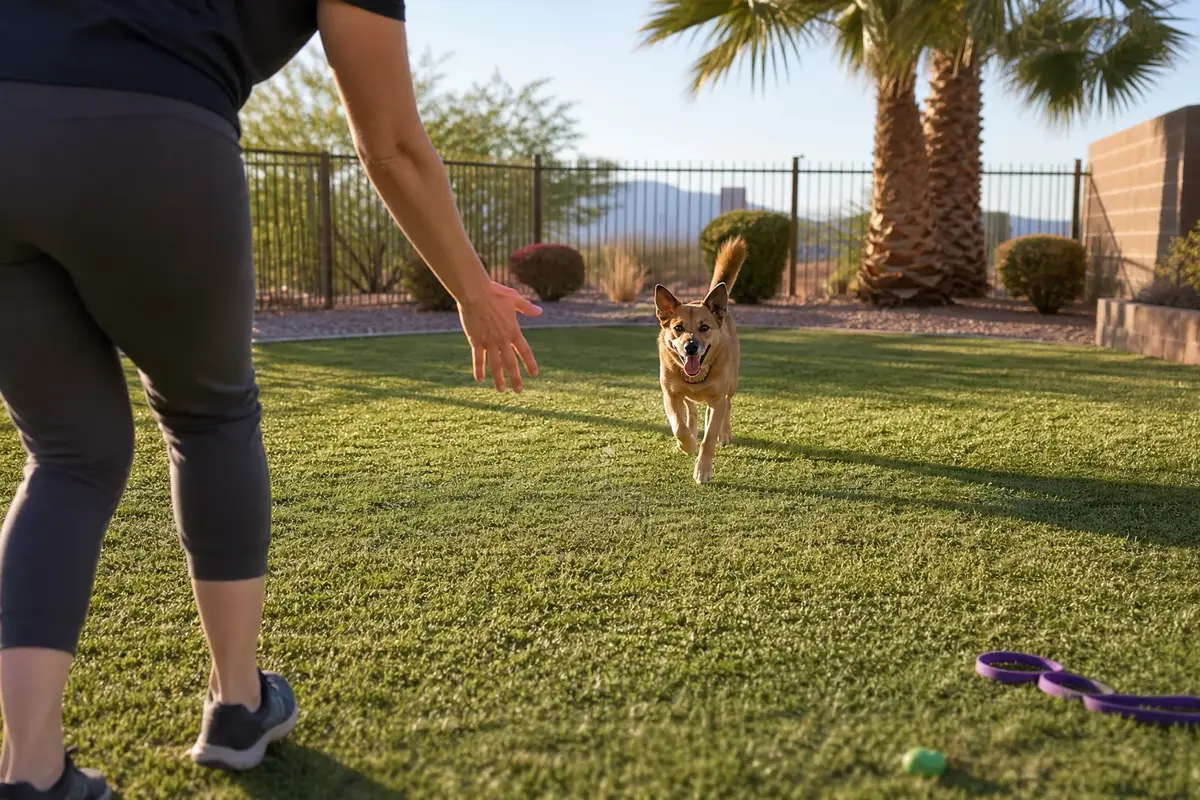
| Distance | Move farther from the dog | Recall on a long line across a yard |
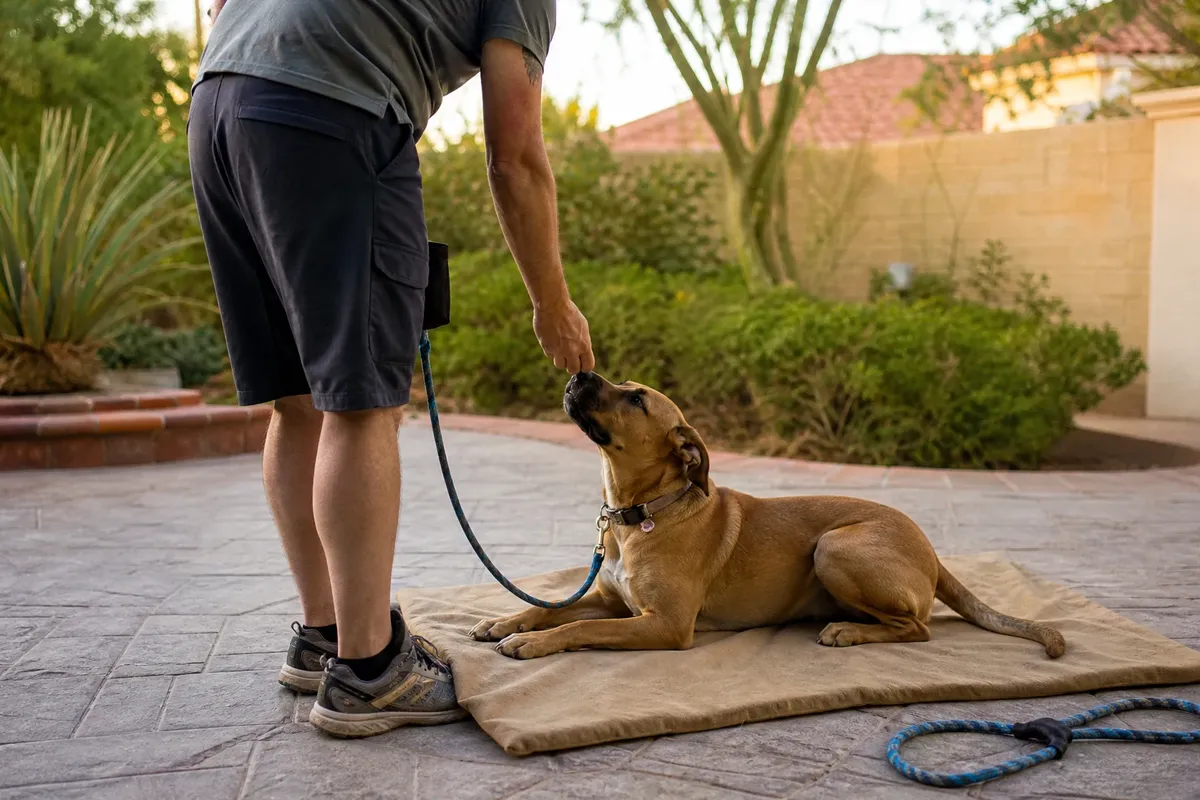
| Duration | Ask for longer holds | Settle on a mat through a meal |
| Location | Move to new places | Practice at a quiet park edge, then a busier one |
We raise only one variable at a time. If the dog fails, we make the task easier, not louder.
Who is advanced obedience for, and who is not it for?
It suits dogs that have finished a basics course or can already do the core cues at home. It does not suit a dog that is still learning sit, or one that is reactive, fearful or has bitten someone. For those, a behavior plan comes first, and we ask you to tell us when you choose a program so we can plan safely.
- Right fit: your dog is easy at home and falls apart outdoors
- Right fit: you want a solid recall or a polite door and gate routine
- Not yet: pulling and jumping are still daily; start with basic obedience
How do we train it?
We use reward-based training, management and prevention, gradual desensitization and counter-conditioning, and short consistent sessions. A long line gives safety during recall work. We raise the reward value when the world gets harder, because a dog cannot be expected to choose you over a squirrel for a dry biscuit.
- Review the basics and fix any weak cue in a quiet place
- Add a mild distraction at a distance the dog can handle
- Reward well, then close the gap in small steps
- Change location and repeat so the cue generalizes
- Thin food rewards and add real-life rewards such as sniff breaks
We use humane tools only. AVSAB and AAHA advise against aversive tools, and an advanced dog is not an excuse to add them.
Where do we practice advanced obedience in North Las Vegas?
We practice in places that are safe, legal and realistic. The city's park rules say dogs and cats must be leashed unless in a designated area, and are barred from sports fields, sports courts, skate parks and children's play areas. Craig Ranch Regional Park lists three designated dog parks with daily hours of 6 a.m. to 11 p.m., closed Wednesdays 6 a.m. to 8 a.m. for maintenance (city page via archive snapshot; confirm). We do not know which of the three is for small or large dogs, so check on site.
For distraction work we usually prefer a quiet leashed outing over an off-leash dog park, because a dog park is a place where you cannot control the other dogs. For longer trail practice, Nevada State Parks says Ice Age Fossils State Park welcomes dogs on a leash of not more than six feet, and trails there run along the Upper Las Vegas Wash, where conditions vary. Check hours and current conditions before you go.
Last verified 2026-11-17.
What does a common North Las Vegas advanced-obedience situation look like?
A common situation North Las Vegas owners face: a dog that is perfect in a fenced yard but pulls toward a neighbor's gate the instant a dog barks behind it. The dog is not stubborn. The training stopped before it reached the real distraction.
We would split the problem: first hold the stay with a mild sound, then add a barking recording at low volume, then work at a distance from a real gate, always rewarding the dog for staying with you. The city's barking process begins with a welfare check and a warning on a first complaint, so a dog that stays calm through neighborhood noise is also good for relations with the neighbors.
Dust and wind matter, too. NWS Las Vegas says winds over 50 mph are infrequent but are probably the most provoking element in the valley because of blowing dust and sand. On those days we train indoors and keep things short.
What should you ask before starting advanced work?
Ask any trainer, us included, how they will raise difficulty and what they do when a dog fails a step. A good answer is "we make it easier and rebuild," not "the dog needs a correction." Ask which tools they use and what they do if your dog gets stressed, and expect plain, specific answers.
- What does a failed repetition look like, and what do we change next?
- How do you decide when a dog is ready for off-leash work, and in which places?
- Which tools are used, and are any of them painful or startling?
- How will you coach me to practice between sessions?
We welcome all of these questions. Our questions to ask guide lists more, and our methods and red flags page explains why we avoid aversive tools. Advanced training also takes homework: plan on short daily sessions, a long line, and a reward you can carry in a pocket during summer walks without it melting.
Frequently asked questions
How do I know my dog is ready for advanced work?
If your dog performs the core cues reliably at home with only mild distraction, you are ready. If not, we will tell you plainly and suggest basics first.
Will my dog be off leash after this?
Not automatically. Off-leash reliability depends on the dog, the place and your habits, and in the city leashes are required outside confined or designated areas. See our off-leash training page.
Do we use a long line?
Yes. A long line lets the dog practice distance and recall safely while we keep control.
Is there a test or title?
Advanced obedience is about skills in daily life. If you want a title such as Canine Good Citizen, we have a separate preparation page.
How long does it take?
That depends on the dog and on your consistency. We raise difficulty only after the dog succeeds at the current level.
Keep reading
- Private in-home dog trainingRead more →
- Online dog trainingRead more →
- Basic obedience trainingRead more →
- Recall trainingRead more →
- Off-leash trainingRead more →
- Choose in-person or onlineRead more →
Sources
- City of North Las Vegas, Craig Ranch Regional Park (last verified 2026-11-17)
- City of North Las Vegas, Parks and park rules (last verified 2026-11-17)
- Nevada State Parks, Ice Age Fossils State Park (last verified 2026-11-17)
- City of North Las Vegas, Animal Noise Complaints (excerpt) (last verified 2026-11-17)
- NWS Las Vegas, Climate of Las Vegas (last verified 2026-11-17)
- AVSAB Humane Dog Training Position Statement (Purdue Canine Welfare Science Center) (last verified 2026-11-17)
- AAHA 2015 Canine and Feline Behavior Management Guidelines (last verified 2026-11-17)
Basics are solid but real life still breaks them? Tell us where your dog slips and what distracts him.
- In-person training in North Las Vegas and nearby areas
- Online training anywhere
- Reward-based methods only