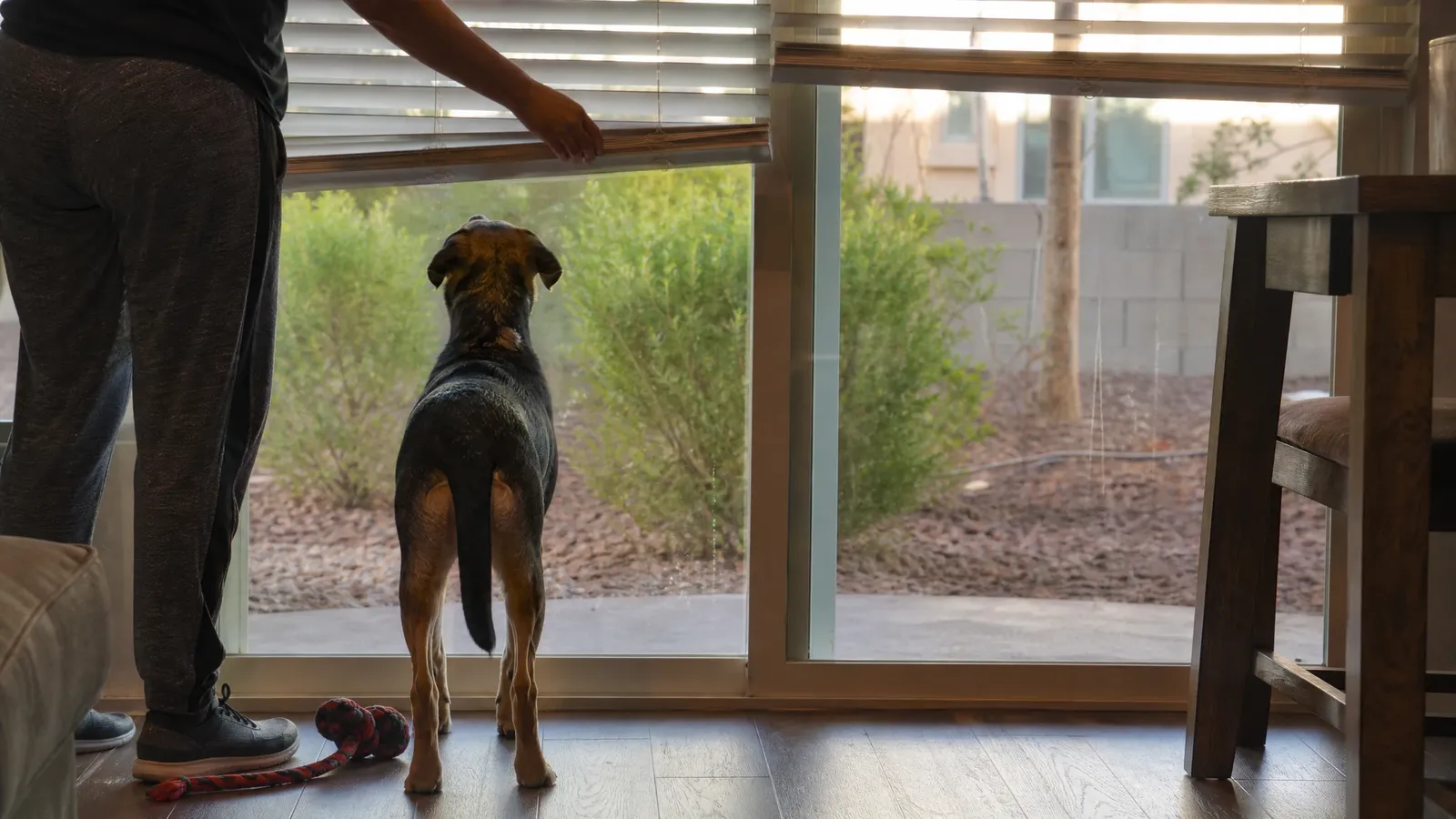
Dogs bark to say something, so the fix is to find the reason and then change the trigger, the setup and your dog's habits with rewards. We help North Las Vegas owners cut barking without bark collars or punishment, and we explain how the city's complaint steps work so you can get ahead of them.
Tell us when your dog barks, from the patio door to the backyard block wall
- In-person training in North Las Vegas and nearby areas
- Online training anywhere
- Reward-based methods only
Why does my dog bark so much, and what is it telling me?
A bark at the gate, a bark at 2 a.m. and a bark when you leave are three different problems, and each needs its own fix. Work out which one you have before you train anything.
| Pattern | Likely cause | What helps |
|---|---|---|
| At the window, patio door or fence when people or dogs pass | Alerting or territorial excitement | Block the view, reward quiet, teach go-to-mat |
| Barking when you leave | Distress; see separation anxiety | Gradual absence training |
| Demand barking at dinner or on the couch | Attention-seeking that has paid off before | Reward quiet, then give attention when calm |
| Outside at night | Wildlife sounds, boredom | Bring the dog inside, supervise yard time |
| Barking on walks | Fear or frustration; see leash reactivity | Distance and counter-conditioning |
What can I do today to reduce barking?
Start with management, because it works fastest. A dog who cannot practice barking all day stops getting paid for it.
- Cover the lower half of street-facing windows and sliding doors with film, or close the blinds.
- Keep your dog off the patio or block-wall line when you cannot supervise.
- Add a job: a snuffle mat, a food puzzle or a sniffy walk in the cooler part of the day.
- Reward every quiet moment, especially right after a trigger.
- Do not shout; to your dog it can sound like you are joining in.
- Ask your vet to check a dog whose barking suddenly increases, especially an older dog.
A mistake we often see: giving a treat in the middle of a barking fit, which pays for the bark. Wait for a breath of quiet, mark it and then reward. Keep sessions to a few minutes and repeat them through the day.

What does North Las Vegas do about barking dogs?
Here is the process as the city's page describes it (see City of North Las Vegas, Animal Noise Complaints). The first complaint on an animal brings a welfare check and a warning. A second complaint on the same animal and property goes to mediation through the Clark County Neighborhood Justice Center. If the noise continues after mediation, Animal Protection Services can send a report to the City Attorney's Criminal Division, but the page says that requires the complainant to record at least ten minutes of video or audio on at least five separate occasions with time stamps, plus witness statements from neighbors. The ordinance wording is that no owner may permit an animal to make noises that, because of duration or repetition, a reasonable person would consider an unreasonable intrusion into the quiet enjoyment of their property.
Why this matters locally: RentCafe, a secondary third-party summary of Census data, puts about 36% of households as renters (RentCafe), so many dogs live a wall away from a neighbor. And the park side has its own noise rule: city parks have noise rules from 11 p.m. to 7 a.m. (city parks page). Coyotes are another trigger. The city says coyotes are found throughout Nevada in urban and rural areas, and a news report quotes Nevada Department of Wildlife advice not to let small dogs out alone from dusk to dawn (KTNV). A dog left on the patio at night may be barking at something real.
A common situation North Las Vegas owners face: a dog on a patio with a view of a shared walkway, barking at every passing neighbor, and a first notice on the door. The plan starts by changing the dog's setup and noticing the first warning as a chance to fix things before mediation.
Last verified 2026-11-17. Noise and complaint rules can change, so read the city's current barking page before you talk to a neighbor or file anything.
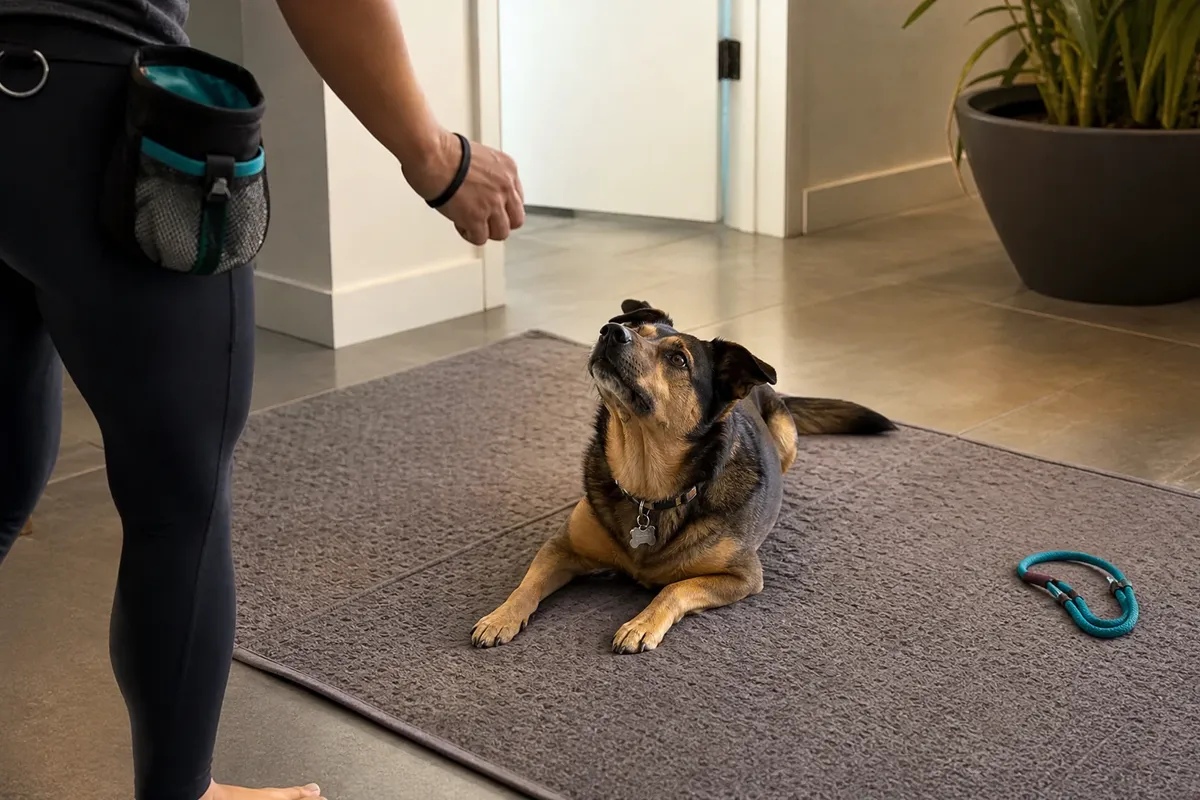
How do we train a dog to bark less?
We change what the dog does when the trigger appears. Rewards for quiet, lots of management and short sessions beat any collar.
- Log the barking: when, where and what happened just before, so we know the trigger.
- Block and reduce: window film, a different room, white noise, supervised yard time.
- Teach "quiet" and "go to mat": the dog earns food for being calm instead of barking.
- Desensitize to the trigger: doorbell, footsteps, passing dogs, at a volume and distance your dog can ignore.
- Meet needs: exercise, play and sniffing, so energy does not pile up.
Veterinary behavior bodies (AVSAB, AAHA) advise against aversive tools, so we do not use bark collars that shock or spray. See the AVSAB position. Timelines depend on the dog and how consistently the household practices.
Is in-person or online training better for barking?
Barking depends on place, so seeing your windows, patio and entry helps. In-person training fits barking that involves visitors or neighbors. Online works well for video review, trigger logs and follow-up. Compare in-person private training with online dog training, then choose your program.
Frequently asked questions
Can the city fine me for my dog's barking?
The city has a staged complaint process: welfare check and warning, mediation, then possible referral to the City Attorney if noise continues. It sets documentation requirements for that last step. Read the city page for current details.
Do anti-bark collars work?
Not in the way you need. A collar that startles or hurts can interrupt a bark, but the reason behind it is still there. We use rewards and management to change that reason instead.
How do I talk to a neighbor about my dog barking?
Listen first, thank them for raising it and share your plan. Showing you are working on it can calm a situation before it becomes a complaint.
Should I let my dog bark it out?
No. Barking that is not addressed tends to get stronger because the dog gets practice and often gets a result. Interrupt the setup and reward quiet instead.
Does a bigger yard fix barking?
Not usually. Dogs left outside often bark more because they see and hear every trigger. Time outdoors works best when supervised and given a job.
Keep reading
- Separation anxiety trainingRead more →
- Apartment dog training in North Las VegasRead more →
- North Las Vegas leash laws and licensingRead more →
- In-person private dog training in North Las VegasRead more →
- Online dog training for barkingRead more →
- Choose in-person or online trainingRead more →
Sources
- City of North Las Vegas, Animal Noise Complaints (page opened via archive snapshot) (last verified 2026-11-17)
- RentCafe, North Las Vegas rental market (secondary; third-party summary of Census data) (last verified 2026-11-17)
- City of North Las Vegas, Parks and park rules (page opened via archive snapshot) (last verified 2026-11-17)
- KTNV 13 Investigates, urban coyote encounters (last verified 2026-11-17)
- AVSAB humane dog training position (via Purdue Canine Welfare Science Center) (last verified 2026-11-17)
Tell us when your dog barks, from the patio door to the backyard block wall
- In-person training in North Las Vegas and nearby areas
- Online training anywhere
- Reward-based methods only