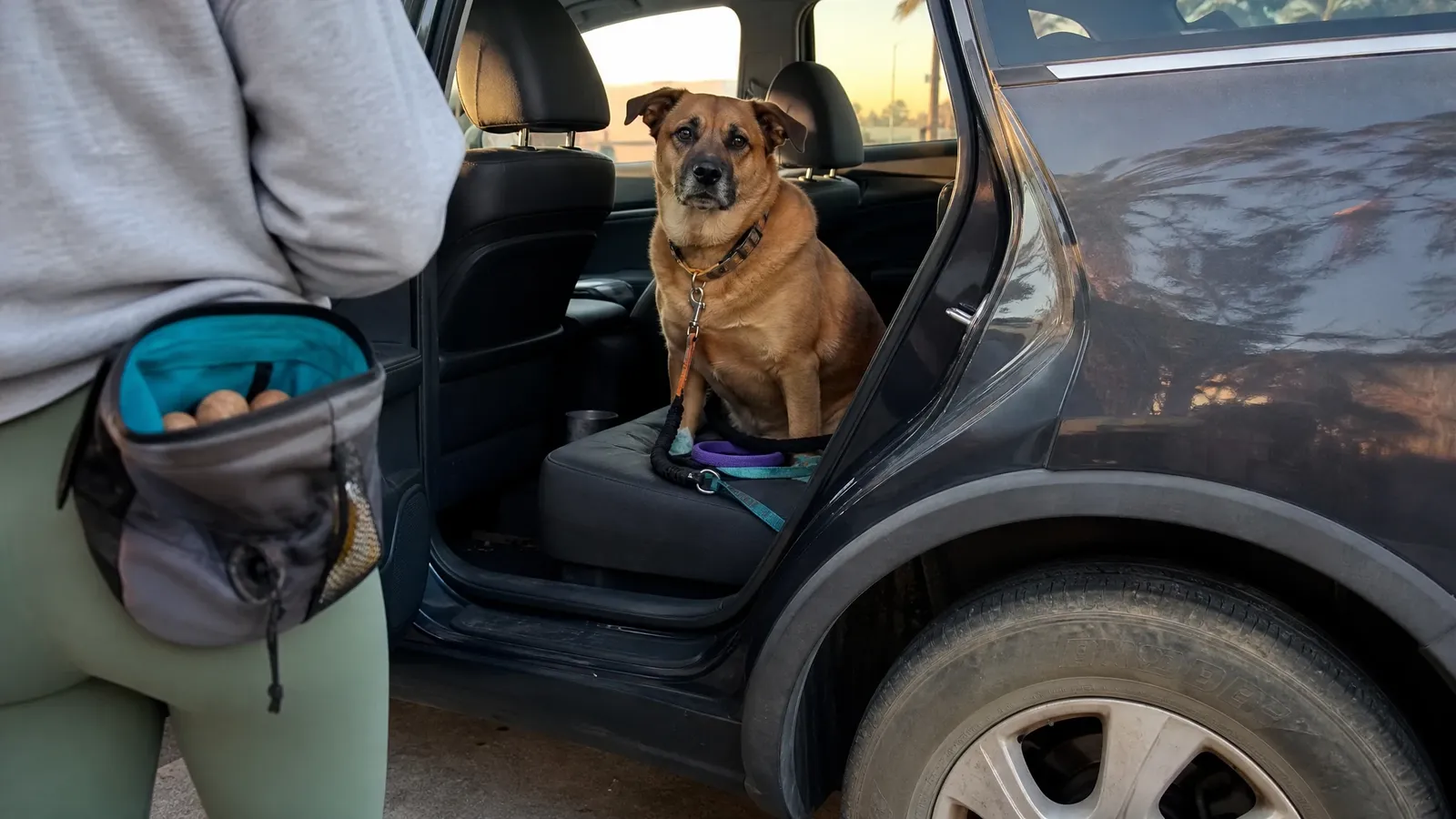
Car fear usually improves with tiny positive steps: the parked car, the engine, a few feet of movement, then short trips to somewhere good. In North Las Vegas the heat adds a safety rule to that plan, because a parked car can be dangerous within minutes and the practice has to happen at cool times of day.
Tell us how your dog handles the car, from the driveway to a trip to Ice Age Fossils State Park
- In-person training in North Las Vegas and nearby areas
- Online training anywhere
- Reward-based methods only
Why is my dog afraid of the car?
Usually because the car has meant something unpleasant, or because the motion, noise and confinement are overwhelming. A dog whose only rides end at the vet, the groomer or the shelter learns that the car predicts bad things.
Other causes:
- Motion sickness, especially in puppies, which teaches a dog to dread the car
- A frightening event in or near a car, like a loud noise or a sudden stop
- No slow introduction to a car during early socialization
- A rescue dog whose ride history is unknown
Nausea and fear look alike. If your dog drools heavily or vomits, tell your vet; treating the nausea can remove much of the fear, and training works better afterward.
What does car anxiety look like, and where do we start?
We start where the fear starts. This table maps what you see to our first step.
| Where the fear starts | What you see | Where we begin |
|---|---|---|
| At the sight of the car | Pulling away, freezing | Treats and play near the parked car, far from the door |
| At the door or seat | Will not jump in, has to be lifted | Rewarding each step toward the seat, engine off |
| When the engine starts | Trembling, panting, whining | Engine on for seconds, then off, with food |
| When the car moves | Drooling, vomiting, barking | Moving a few feet, then short fun trips, and a vet check for nausea |
Do not force a frightened dog into the car and do not scold drooling or vomiting. Those are signs of distress, and scolding makes the car worse.
How does North Las Vegas heat change car training?
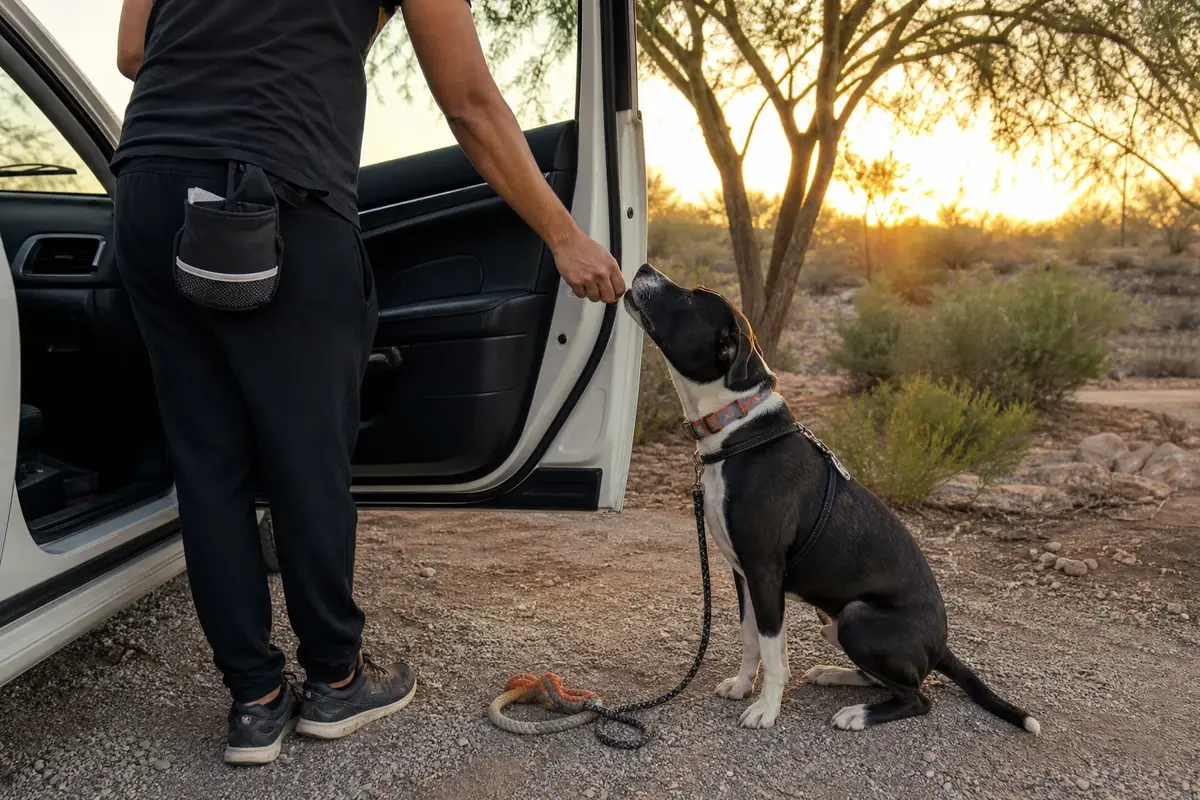
It decides when and where you practice. Clark County Animal Protection Services warns that pavement can be 40 to 60 degrees hotter than the air and can burn paws in seconds, and tells owners to walk pets in the early morning or late evening. A dog that is already nervous about the car will not forget a burned paw or a hot seat, so heat can create a new fear on top of an old one.
NWS Las Vegas describes hot summers that reach into the triple digits. We plan summer practice for early morning in shade, keep engine-off steps short, and cool the car with the doors open before the dog gets in. We never leave a dog in a parked car, even for a quick errand, and we advise sun shades, a cool seat cover and water for any ride.
Cooler months are the best time to build the skill. A dog that rides calmly in November is much easier to take to the vet in July.
A common situation North Las Vegas owners face: from the shelter to the vet
Here is a common situation North Las Vegas owners face. A dog is adopted from The Animal Foundation, which is the contracted shelter for the cities of Las Vegas and North Las Vegas, and rides home worried. The next ride is the first vet visit, then a trip to a groomer. Within a few weeks the dog will not approach the car.
The owner wants easy outings, like a leashed walk at Ice Age Fossils State Park, where Nevada State Parks says dogs are welcome on a leash of no more than six feet, and a drive across the valley is the barrier.
We separate the car from the bad destinations. Car seat, treat, short ride, something fun, home. Over a few weeks, the vet is only one trip among many pleasant ones. Practice the routes you will really use so the dog is not surprised by highway noise.
A local audience insight: the 24-hour emergency hospitals we verified are in the Las Vegas valley, not inside North Las Vegas, so an emergency trip is a drive. Dogs that ride calmly are easier to get to care when it matters, which is a good reason to train this before an emergency.
How we train dogs to ride calmly
We use gradual desensitization and counter-conditioning with food, short sessions, management and owner coaching. We do not push the dog in, flood it with a long drive, or use corrective tools.
- Car is a feeding spot. Meals or treats near the parked car, then on the seat with the door open.
- Door closed, engine off. A few seconds, then a release and a reward.
- Engine on. Brief and quiet, with food, then off.
- Moving. A few feet in the driveway, then around the block.
- Fun destinations. Short trips to somewhere the dog loves, then home.
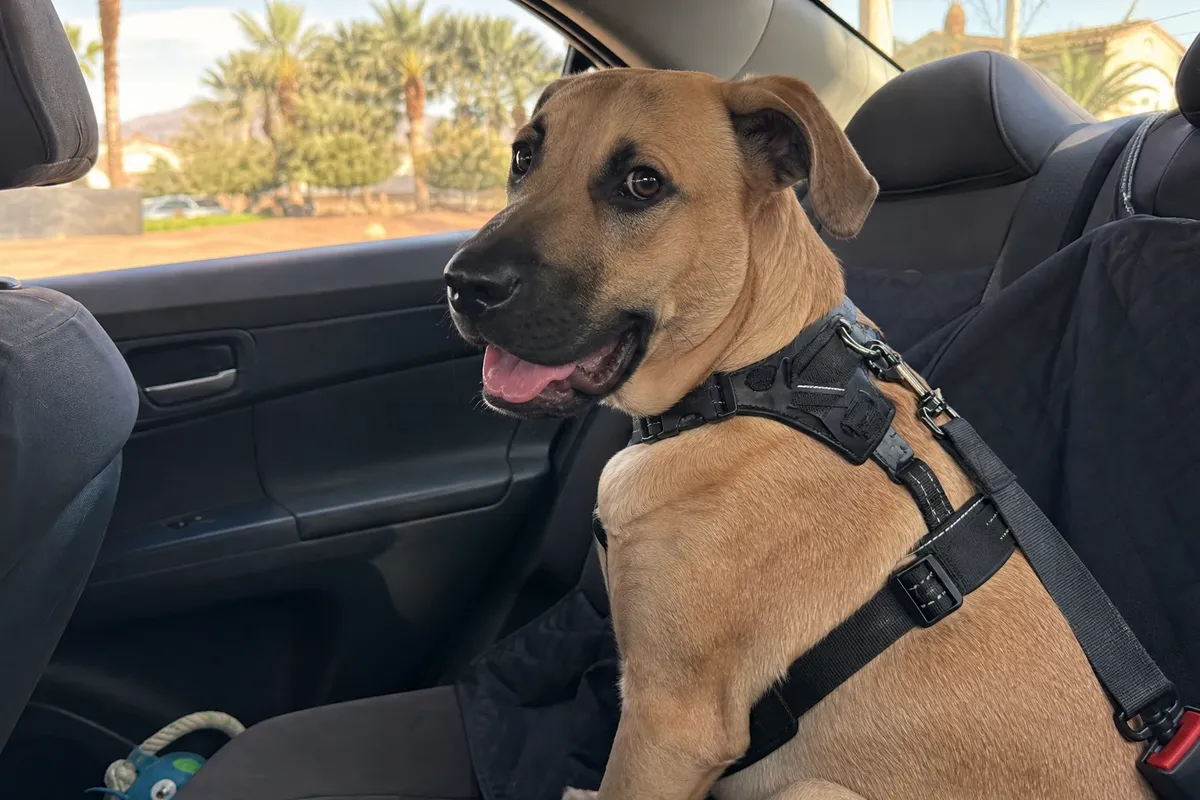
- Safe travel. A crash-tested harness or secured crate, so the ride is calmer and safer.
How long this takes depends on the dog, its history and how consistently you practice. We set small goals and review them each session.
Is in-person or online training better for car anxiety?
Online lessons work for the early steps because they happen at your parked car and we coach your timing from video. In-person lessons help when the dog is very fearful, when it has been sick in the car, or when we need to see how your dog loads into your specific vehicle. Tell us if your dog has a bite history or if car fear shows up as snapping, so we can choose the safest plan.
We can combine them: start online in the driveway, then add an in-person session for the first real drive.
Frequently asked questions
Why does my dog throw up in the car?
It can be motion sickness, anxiety or both. Puppies are especially prone to nausea. Check with your vet, because treating the nausea often makes the training easier.
Can I train car anxiety without driving?
Yes. The first steps happen with the car parked: feeding near it, then on the seat, then with the engine on. That builds comfort before any driving.
Is it safe to practice in summer?
Only at cool times of day and never with a dog left in a parked car. We schedule early-morning practice, keep engine-off steps short, and cool the car before the dog gets in.
How long until my dog rides calmly?
It depends on the dog, its history and how consistently you practice. Some dogs improve in a few weeks and others need a slower plan. We do not promise a date.
Should my dog ride in a crate or a harness?
Either can work if it is secured and your dog is comfortable in it. We introduce the harness or crate in the house first so it becomes a cue for good things, not a restraint that adds fear.
Keep reading
- Choose in-person or online dog trainingRead more →
- in-person car-ride training with your own vehicleRead more →
- online dog training for gradual practiceRead more →
- help for separation anxietyRead more →
- vets and emergency vets near North Las VegasRead more →
- puppy socializationRead more →
Sources
- Clark County, pet heat safety news release (last verified 2026-11-17)
- NWS Las Vegas, Climate of Las Vegas (last verified 2026-11-17)
- The Animal Foundation, Adoption (last verified 2026-11-17)
- Clark County Animal Protection Services FAQ (last verified 2026-11-17)
- Nevada State Parks, Ice Age Fossils State Park (last verified 2026-11-17)
- VEG Las Vegas (last verified 2026-11-17)
Tell us how your dog handles the car, from the driveway to a trip to Ice Age Fossils State Park
- In-person training in North Las Vegas and nearby areas
- Online training anywhere
- Reward-based methods only