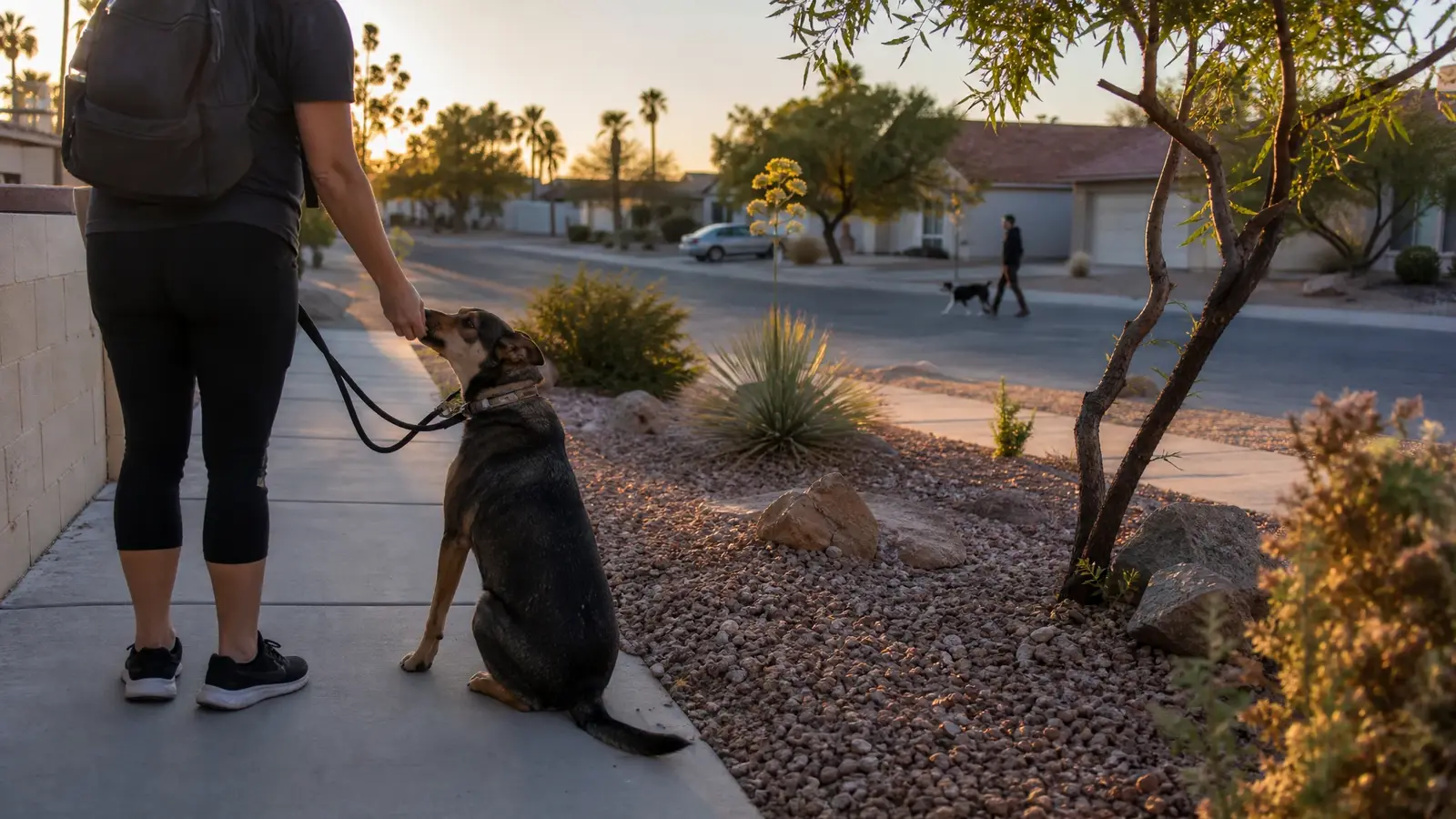
Leash reactivity is a dog who barks, lunges or spins at other dogs or people while on a leash, and it is a feeling problem before it is a manners problem. We help North Las Vegas owners lower the intensity with distance, rewards and gradual exposure, never with leash corrections or shock.
Tell us who your dog reacts to on walks, from your block to the Craig Ranch dog parks
- In-person training in North Las Vegas and nearby areas
- Online training anywhere
- Reward-based methods only
Why does my dog lunge and bark at other dogs on walks?
The leash takes away your dog's option to retreat or greet politely, so the same dog who plays well off leash may bark and lunge on it. The barking is usually distance-increasing: it says "go away" or "let me get there." Fear, frustration, over-excitement and past scary encounters all look similar from the outside.
| What you see | Often means | Where we start |
|---|---|---|
| Stiff body, hard stare, then lunge | Fear or "keep away" signaling | More distance, rewards for a soft look |
| Whining, pulling hard, then barking | Frustration at being held back | Teach a calm approach and a turn-away cue |
| Happy wiggling that turns to barking | Over-excitement | Reward four paws on the ground and sitting before greeting |
| Reacts only to one type of dog or person | Learned fear of that trigger | Gradual exposure at a distance the dog can handle |
Veterinary behavior guidance (AVSAB) says reward-based methods are supported for all canine training and that there is no evidence aversive training is necessary. See the AVSAB statement via Purdue.
What can I change on the next walk?
Change the distance first, because everything else depends on it. A dog who is calm enough to take a treat is a dog who can learn.
- Cross the street, step behind a parked car or turn around as soon as your dog notices a trigger, before the barking starts.
- Pay for noticing: every time your dog looks at a trigger and stays quiet, say "yes" and deliver a treat.
- Keep the leash loose and your hands low. Tension travels down the leash and tells your dog something is wrong.
- Pick quieter walking windows and wider routes while you train; a long loop around a block is a fine training choice.
- Skip dog-park greetings for now. A reactive dog does not need more on-leash meetings.
- End the walk on a good moment instead of pushing for one more pass.
Skip leash jerks, yelling and "let them work it out." They raise arousal and can teach your dog that the trigger predicts something unpleasant, which makes the reaction worse.
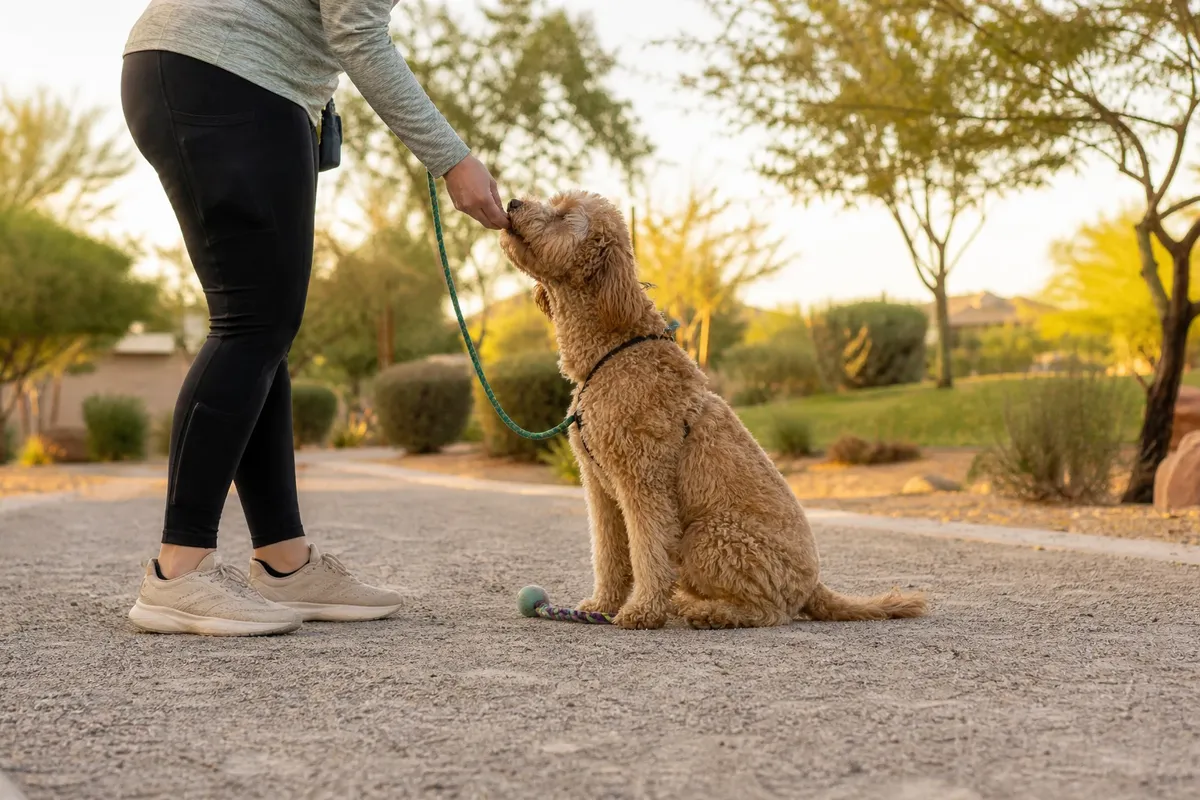
What does North Las Vegas expect of a dog on a leash?
The city page says all pets, regardless of age or size, must be leashed at all times unless confined on or within the owner's property, and that letting an animal run at large is unlawful with a fine of up to $1,137 per offense (see City of North Las Vegas Animal Protection Services). The city's published page states no leash length. For city parks, the city parks page adds that dogs must be leashed unless in a designated area, and that dogs are barred from sports fields, sports courts, skate parks and children's play areas.
Craig Ranch Regional Park lists three dog parks open daily 6 a.m. to 11 p.m., closed Wednesdays 6 a.m. to 8 a.m. for maintenance (the city's page says so; see Craig Ranch Regional Park). A reactive dog is usually better off skipping them while we work, because off-leash greetings are exactly where reactivity gets practiced. Two further places that matter on walks: Ice Age Fossils State Park allows leashed dogs on a leash of not more than six feet (Nevada State Parks), and the National Park Service asks visitors at Tule Springs Fossil Beds to keep dogs leashed (NPS).
Summer changes the plan too. Clark County warns that pavement can run 40 to 60 degrees hotter than the air and urges early morning or late evening walks (Clark County). Those cooler windows are also when other dogs are out, so plan your route and your escape turns before you leave.
Last verified 2026-11-17. Park and leash rules can change, so check the city's current page before you pick a practice spot.
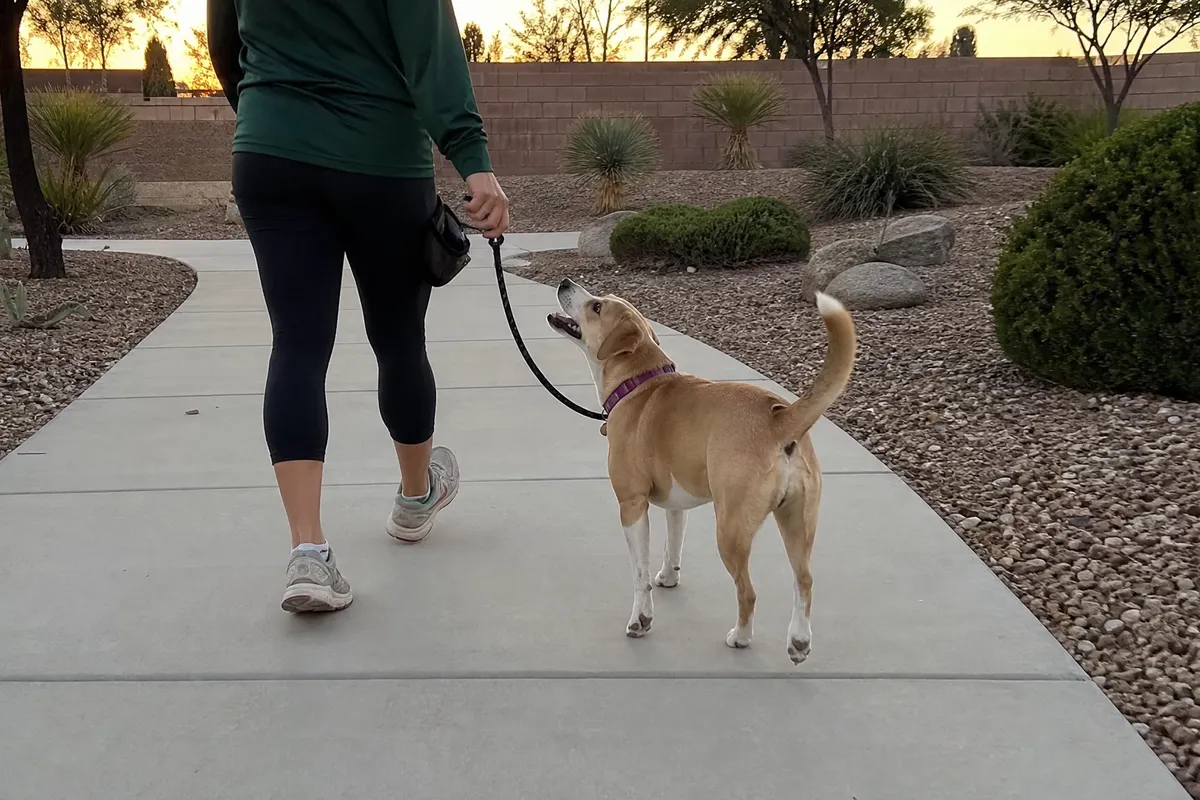
How do we train a leash reactive dog?
We lower the intensity of the trigger first, then change how your dog feels about it. That is counter-conditioning and desensitization, done in short sessions with humane tools like a front-clip harness or a flat collar and a long, loose leash.
- Find the threshold. We map the distance where your dog notices a trigger but can still eat and think.
- Pair the trigger with food. Trigger appears, treats flow; trigger leaves, treats stop. Over weeks, the dog's feeling about the trigger shifts.
- Teach a U-turn and a hand target. These give your dog something to do instead of lunging, and give you a clean exit.
- Build in distance gradually. Only when your dog is relaxed at one distance do we move closer.
- Coach the handler. Leash handling, timing and your own breathing matter as much as the dog's homework.
Progress depends on the dog and on how consistently the household practices. We do not promise a timeline. If your dog has bitten or you feel unsafe, tell us when you choose a program and we will plan around it.
Is in-person or online training better for a reactive dog?
Both can work. In-person training lets our trainers see your leash handling, your street and the real triggers, which helps most when the reactions are intense or when your dog has bitten. Online fits dogs with milder reactions and owners who can film walks for review. Compare in-person private training with online dog training, then choose in-person or online.
Frequently asked questions
Why is my dog fine off leash but reactive on leash?
The leash removes your dog's choices and often adds tension from your hand. A dog who would normally move away or sniff politely may feel stuck and use barking instead. Training works on that feeling and on your leash handling.
Should I let my reactive dog meet other dogs to get used to them?
Not while the reactions are strong. Forced greetings usually add stress. We build calm around other dogs at a distance first and add controlled, planned contact only when your dog is ready.
Do I need a special collar or muzzle?
You do not need prong, choke or shock tools, and we do not use them. A well-fitted harness or flat collar and a loose leash are our starting point. A basket muzzle, trained with treats, can be a useful safety layer for some dogs and we will say so if we think it fits.
Can the city fine me if my dog lunges on a leash?
The city page says the leash law applies to loose pets, with a fine up to $1,137 per offense for letting an animal run at large. A leashed dog reacting is not the same offense, but a bite or an escape raises the stakes, so we focus on control and distance.
How long will it take to fix leash reactivity?
It depends on the dog, the trigger and how consistently you practice. Some owners see calmer walks in a few weeks; others need months. We will not promise a date.
Keep reading
- Leash pulling training in North Las VegasRead more →
- Dog park behavior and etiquetteRead more →
- North Las Vegas leash laws and licensingRead more →
- In-person private dog training in North Las VegasRead more →
- Online dog training for reactive dogsRead more →
- Choose in-person or online trainingRead more →
Sources
- City of North Las Vegas, Animal Protection Services (page opened via archive snapshot) (last verified 2026-11-17)
- City of North Las Vegas, Parks and park rules (page opened via archive snapshot) (last verified 2026-11-17)
- City of North Las Vegas, Craig Ranch Regional Park (last verified 2026-11-17)
- Nevada State Parks, Ice Age Fossils State Park (last verified 2026-11-17)
- National Park Service, Tule Springs Fossil Beds pets page (last verified 2026-11-17)
- Clark County, pet heat safety news release (May 2025) (last verified 2026-11-17)
- AVSAB humane dog training position (via Purdue Canine Welfare Science Center) (last verified 2026-11-17)
Tell us who your dog reacts to on walks, from your block to the Craig Ranch dog parks
- In-person training in North Las Vegas and nearby areas
- Online training anywhere
- Reward-based methods only