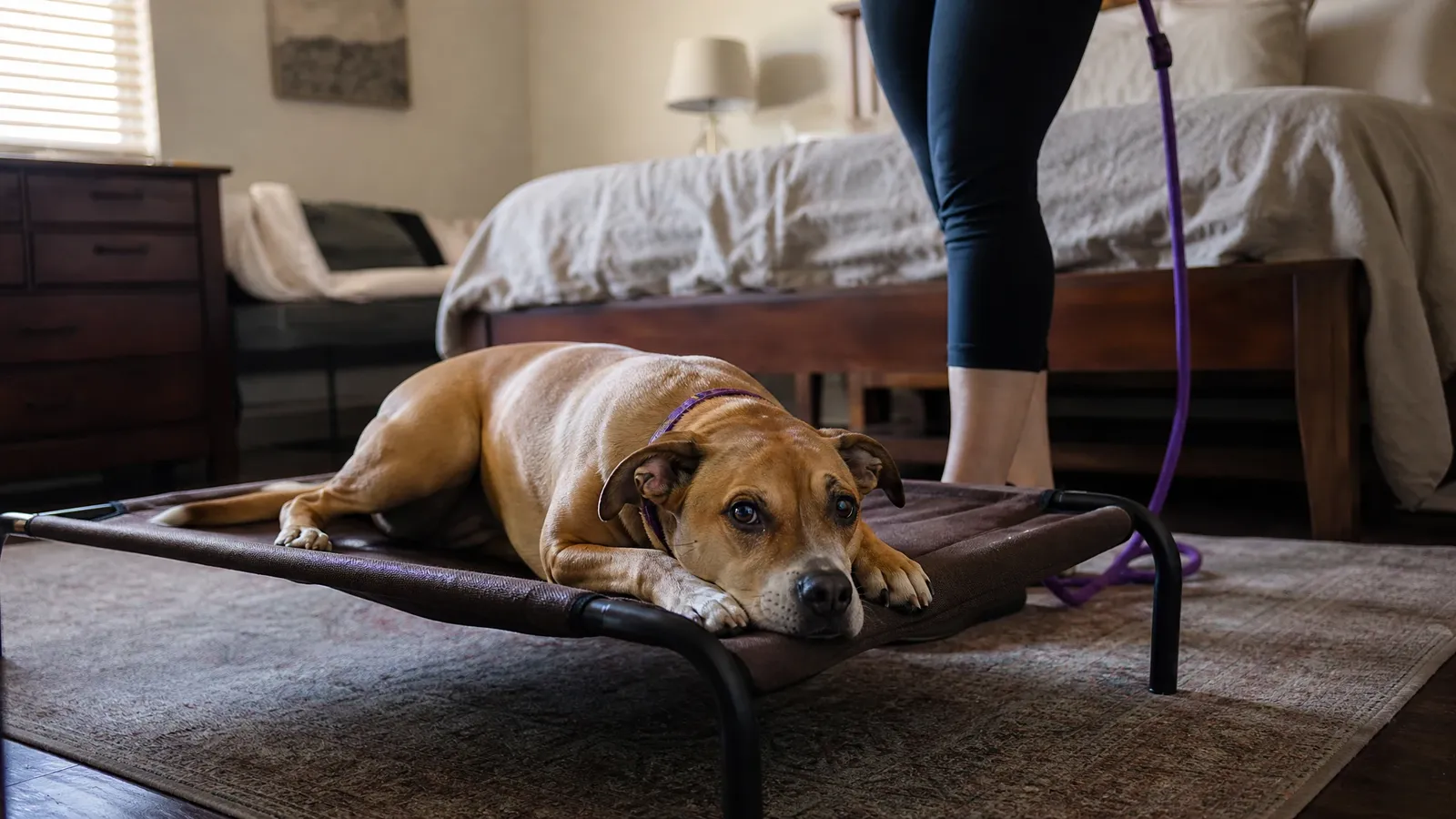
Board-and-train means your dog lives with a trainer for a stretch while skills are taught, then you learn to keep them going at home. It can help busy households, but it is not a shortcut, and the handoff is where it succeeds or fails. Local details here were last verified 2026-11-17.
Thinking about sending your dog away to train? Tell us your dog, your schedule and your worries.
- In-person training in North Las Vegas and nearby areas
- Online training anywhere
- Reward-based methods only
Is board-and-train right for my dog?
It can be right for a healthy, relaxed dog whose owners lack time for weekly lessons, or a dog that needs a lot of repetitions in a short window. It is often wrong for a dog with separation distress, fear or a bite history, because a new place and new people add stress at the worst moment.
| Often a good fit | Often a poor fit |
|---|---|
| Healthy adolescent dog with basic manners to build | Dog with separation anxiety or panic when left |
| Owners with long hours who will commit to the handoff | Owners who plan to skip the follow-up lessons |
| Dog that settles well in new places | Dog that is fearful, reactive or has bitten |
| Goal is foundation skills (manners, leash, recall basics) | Goal is fixing a deep behavior problem in a week |
If your dog has a bite history or a safety concern, tell us when you choose a program. For many problem behaviors, lessons in your own home work better because the behavior happens there.
What does a good board-and-train include?
A good one has daily structure, rest, humane methods and a real handoff to you. Dogs learn in short, rewarded bursts, then need sleep, exercise and downtime. Training is only the part of the day when the dog is working; the rest is how the dog lives.
- A written plan: which skills, how they will be taught and how progress is measured
- Reward-based methods and humane tools only, described in plain words
- Daily updates you can understand, with short clips of real training
- Several owner lessons so you can handle the dog yourself
- Safe housing, shade and cooling in summer, and clear rules about contact with other dogs
- A plan for a dog that does not settle: when does the trainer stop and call you?
We do not promise a finished dog. A dog that behaves for the trainer will still need you to practice, because the habits belong to the household, not only the dog.
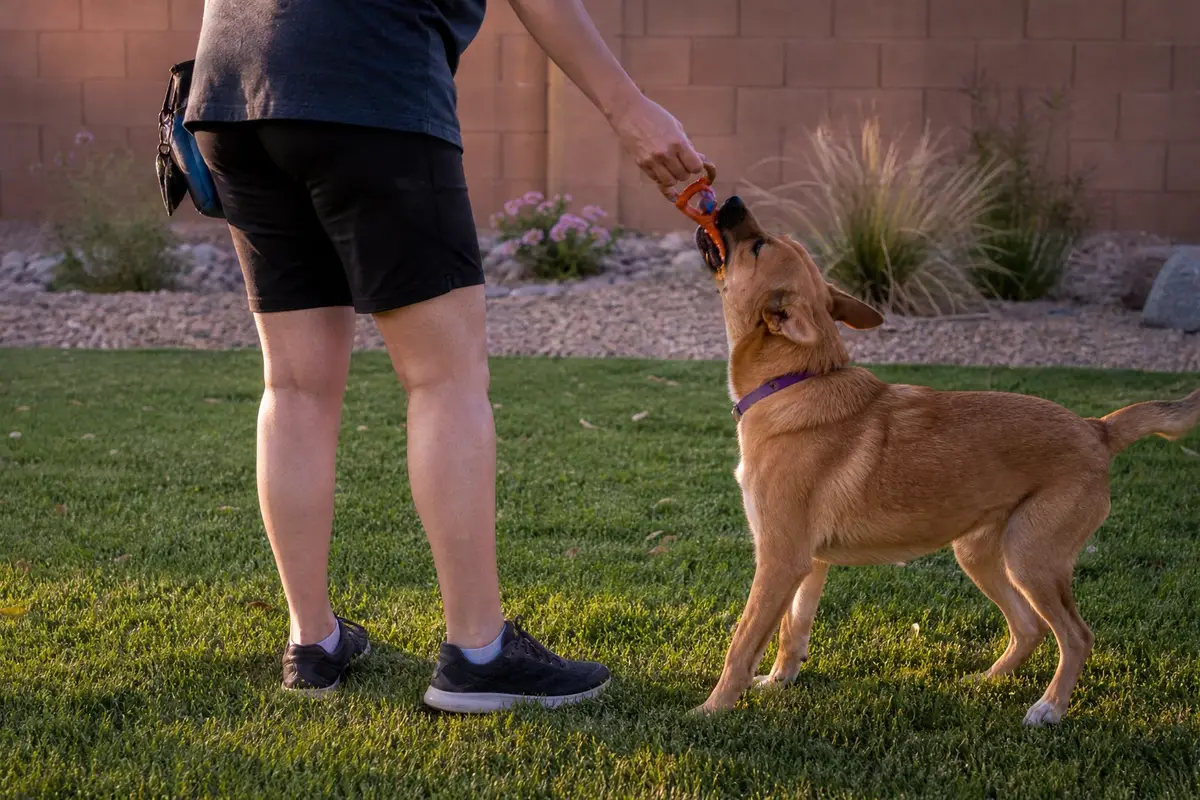
How should you vet a board-and-train program?
Ask any trainer, us included, to describe a normal day for the dog and a bad day. A clear, specific answer tells you more than a polished before-and-after video. Ask where the dog sleeps and how long it is crated or left alone, because state law matters here: Nevada state law (NRS 574.100) says a dog may not be restrained by a tether, chain, tie, trolley or pulley under 12 feet in length or one that lets it reach a fence or object that could strangle it, may not be restrained with a prong, pinch or choke collar, and may not be restrained for more than 10 hours in a 24-hour period, with exceptions such as a leashed walk. That is state law, not a city rule.
We did not find published facility rules for local daycare and boarding businesses, and we did not confirm whether the city requires a permit for them, so we make no claim about either. Ask any provider about vaccine requirements, supervision, emergency plans and which vet they use, and get the answers in writing. See our vets and emergency vets page for verified clinics in the Las Vegas valley.
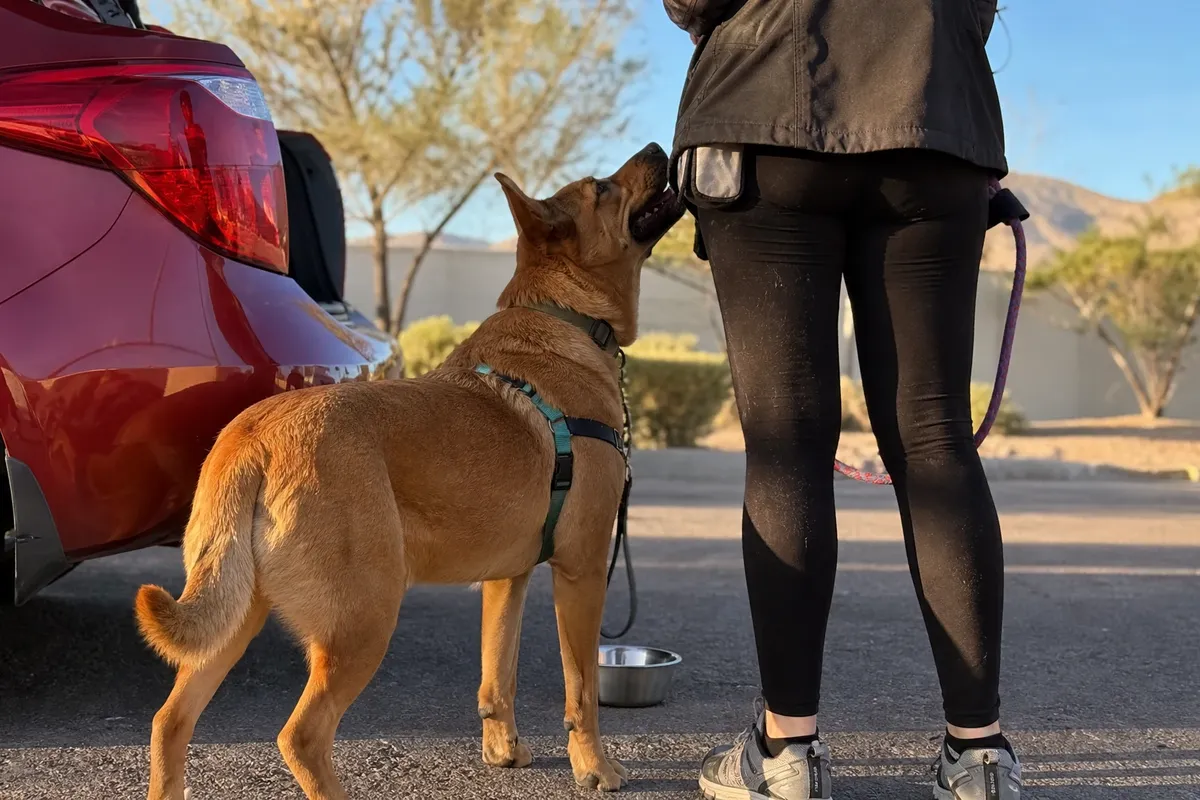
What does it cost, and why do we print no range?
It varies widely, and we could not verify a local range. In our research of local published market prices, we found only one trainer's own page listing a board-and-train rate, and it was stated for existing clients rather than as a general public price. One data point is not a range, so we print none. Aggregator and listing figures were not read on a trainer's own page, so we do not use them.
Ask for a written quote that lists the number of nights or days, how many hours of daily training, what is included (owner lessons, follow-up, food, vet care) and what happens if the dog needs to come home early. Our cost page shows the ranges we could verify for private lessons and group classes, last verified 2026-11-17.
What local factors matter for a North Las Vegas board-and-train?
Heat is first. Clark County Animal Protection Services says pavement can be 40 to 60 degrees hotter than the air, up to 160 F, and warns never to leave a pet in a parked vehicle, since interior temperatures reach lethal levels within minutes. If you are driving a dog to and from a program in summer, plan the drive for early or late, run the air conditioning, and never leave the dog in the car.
July 4 is the second. Clark County says shelter populations typically rise by hundreds over the Fourth of July because fireworks frighten pets, and most lost pets are never reclaimed. A board-and-train that spans the holiday should have a plan for noise: a secure indoor space, white noise, identification and microchip details up to date. The city's license, required for the life of the dog and renewed annually, also helps get a lost dog home; it is $10 for a sterilized dog and $25 for an unsterilized dog per the city page (confirm with the city).
A common situation North Las Vegas owners face is a household that wants a calm dog before a new baby, a move or the summer heat arrives. That is a good reason to plan early, because a dog needs time to practice at home, not just in a program.
How do we make skills stick at home?
The home phase matters more than the boarding phase. We teach owners the same cue words, hand signals and reward timing the dog learned, then rebuild the routine at your address: where the mat sits, how guests are greeted, how the gate opens. Skills fade within days if the household changes the rules.
- Rehearse the daily routine with the trainer present
- Practice short sessions, two or three a day, for the first weeks
- Keep management tools in place (gates, leash, mat) while habits settle
- Check in on setbacks instead of waiting for them to grow
To discuss whether this format fits your dog, choose in-person or online. If a program is not the right fit, we will say so.
Frequently asked questions
Is board-and-train faster than lessons at home?
Not necessarily. Dogs can learn skills quickly in a focused setting, but skills must be practiced at home. Progress depends on the dog and your consistency after the handoff.
Do dogs learn better away from home?
They can learn foundation skills with fewer distractions, but the hard part is carrying them into your own home, where the problems actually happen.
What should I ask before I book?
Ask for a written plan, daily schedule, methods and tools, vaccine requirements, emergency plan and how many owner lessons are included. We invite those questions.
Are shock or prong collars used?
We do not use them. Veterinary behavior bodies, including AVSAB and AAHA, advise against aversive tools, and Nevada state law (NRS 574.100) also restricts restraining a dog with prong, pinch or choke collars.
What does it cost in North Las Vegas?
We could not verify a local range, so we do not print one. Ask any provider for a written quote that lists exactly what is included.
Keep reading
- Private in-home dog trainingRead more →
- Online dog trainingRead more →
- Cost of dog trainingRead more →
- How to choose a dog trainerRead more →
- Separation anxietyRead more →
- Choose in-person or onlineRead more →
Sources
- Nevada Revised Statutes chapter 574 (state law, NRS 574.100) (last verified 2026-11-17)
- Clark County, pet heat safety news release (May 2025) (last verified 2026-11-17)
- Clark County, safe and sane fireworks news release (June 2026) (last verified 2026-11-17)
- City of North Las Vegas, Pet Licenses (last verified 2026-11-17)
- City of North Las Vegas, Animal Protection Services (last verified 2026-11-17)
- Local published market ranges, Las Vegas valley (derived by us from trainers' own published pages; businesses not named) (last verified 2026-11-17)
- AVSAB Humane Dog Training Position Statement (Purdue Canine Welfare Science Center) (last verified 2026-11-17)
- AAHA 2015 Canine and Feline Behavior Management Guidelines (last verified 2026-11-17)
Thinking about sending your dog away to train? Tell us your dog, your schedule and your worries.
- In-person training in North Las Vegas and nearby areas
- Online training anywhere
- Reward-based methods only