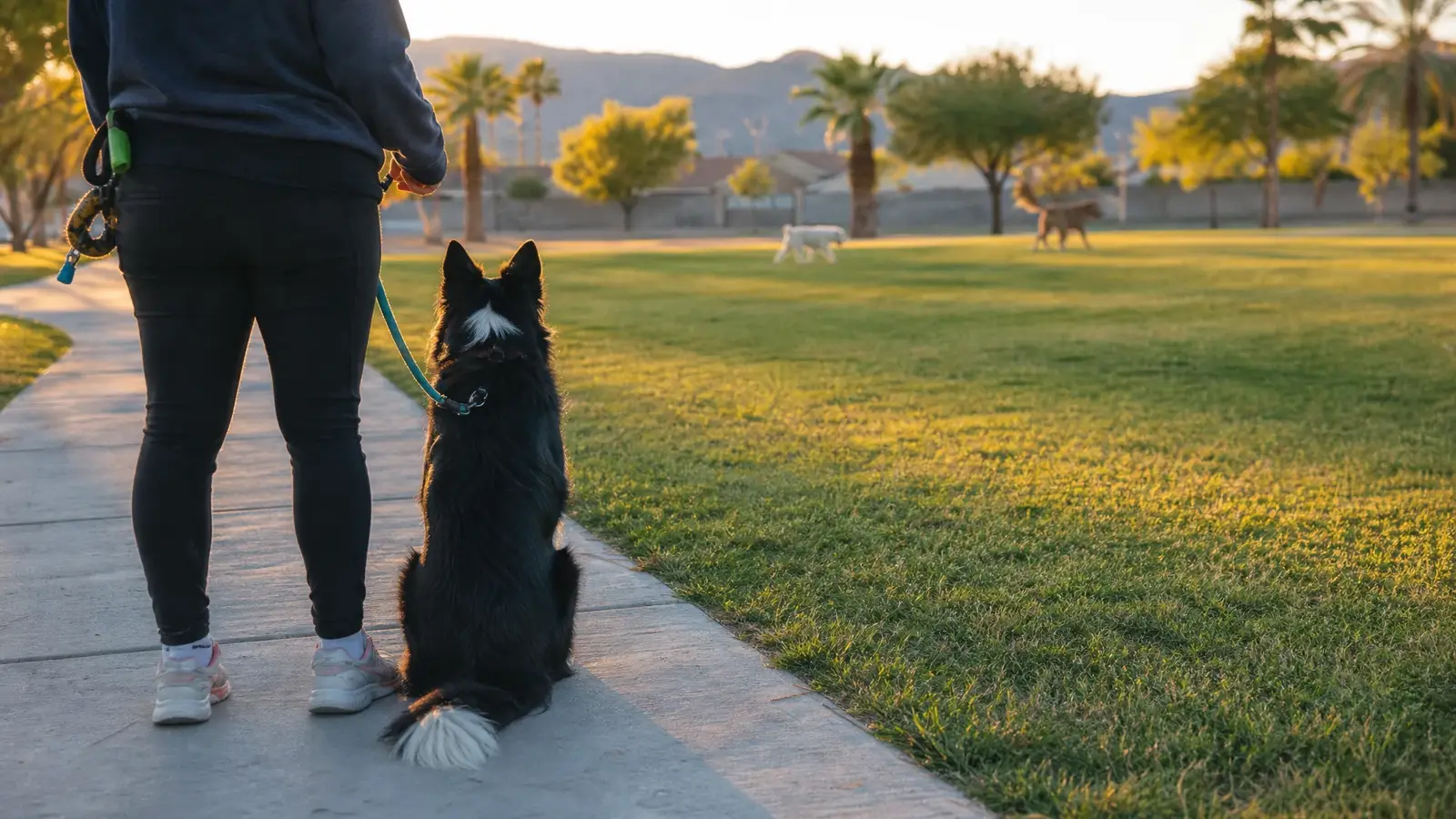
The main types of dog training in North Las Vegas are private in-person, online, group, board-and-train and puppy classes, and the right one depends on your dog and your goal. We compare them here, with local price signals last verified 2026-11-17.
Compare in-person and online training for your dog before you choose
- In-person training in North Las Vegas and nearby areas
- Online training anywhere
- Reward-based methods only
What types of dog training are there in North Las Vegas?
The main types are private in-person training, online coaching, group classes, board-and-train, puppy classes and off-leash or advanced work. They differ in where practice happens, how much one-on-one attention your dog gets and how much you do yourself. We offer in-person and online programs, and we explain the others so you can compare fairly.
| Type | Best for | Watch for | Local price signal (last verified 2026-11-17) |
|---|---|---|---|
| Private in-person | Problems tied to your home, street or neighbors: pulling, door manners, barking, reactivity | You still have to practice daily | Roughly $87 to $155 per hour in the valley (derived) |
| Online coaching | Puppies, manners and mild problems; owners who like video and flexible times | Harder for hands-on leash handling issues; not ideal when safety is a concern | One published source listed a virtual hour at $100 |
| Group classes | Social, confident dogs; basic manners around distractions | A fearful or reactive dog may be overwhelmed | Roughly $120 to $175 for a 5 to 8 week series |
| Board-and-train | A head start while you are away | Skills fade unless you learn to cue and reward; ask what happens day to day | No range verified; ask for a written quote |
| Puppy classes | Early socialization and handling | Check health and vaccine expectations with your vet | Included in the group range where published |
Market ranges here are derived from public pages and are not our prices. Details are on the cost page.
Which type fits your dog?
Use your dog's temperament and your goal to pick. A dog who greets every person happily and settles around other dogs often does well in a group class. A dog who barks and lunges on the leash, guards a bone or panics when you leave needs private work, because we control distance and exposure.
- Pulling, jumping, manners: private in-person or online; both work if you practice.
- Fear or reactivity: private in-person, with gradual desensitization and counter-conditioning at your dog's pace.
- Puppy basics: online coaching or a puppy class, plus private work for biting or potty routine.
- Separation anxiety: private, because it is built around your home and routine.
- Bite history or safety concern: tell us when you choose a program; we start privately with management and distance.
Not sure? Read puppy classes vs private lessons or our aggression guide.
How do we train, whichever type you choose?
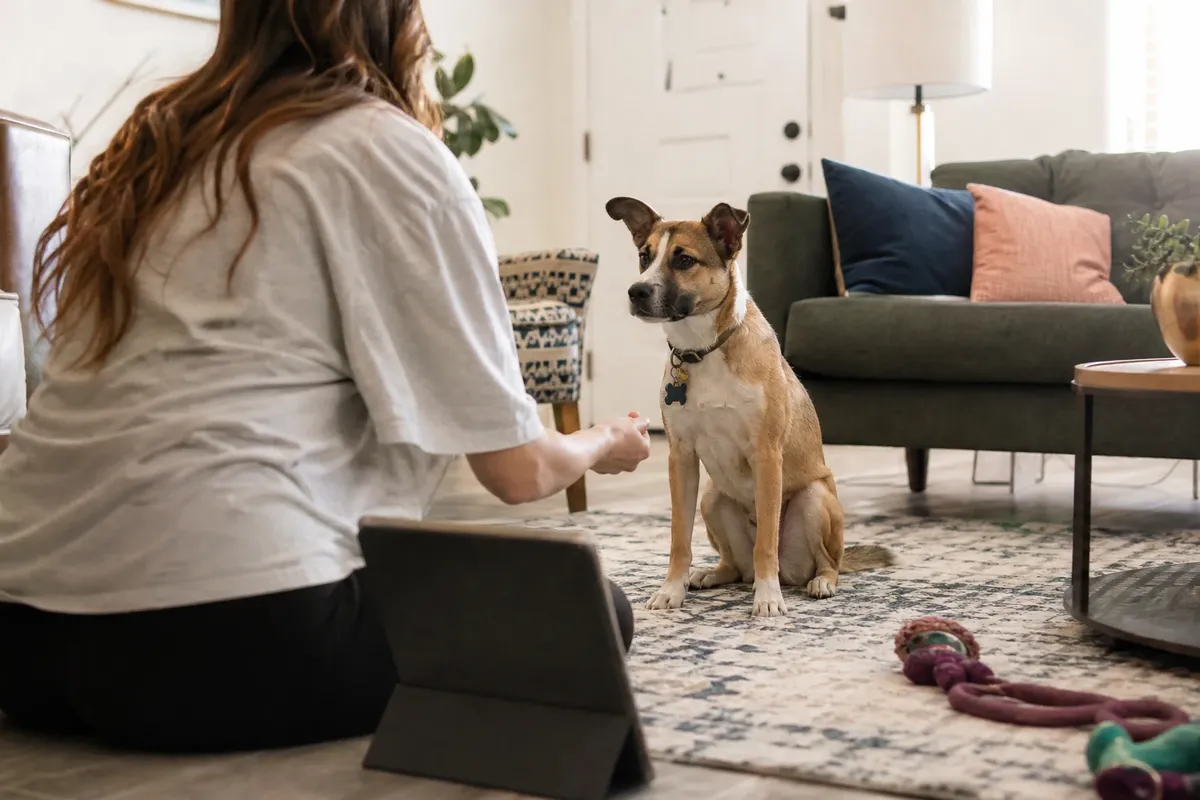
We train with reward-based teaching, management and prevention, gradual desensitization and counter-conditioning, short consistent sessions and owner coaching. We use humane tools only. Nothing about the delivery changes that: the same approach works in your living room and on a video call.
That matches the veterinary behavior view. The AVSAB statement, hosted by Purdue, says evidence supports reward-based methods for all canine training and that there is no evidence aversive training is necessary (AVSAB humane training statement). The AAHA 2015 guidelines say their task force opposes aversive techniques (AAHA take-home messages), quoted here from a search excerpt of the page; check it yourself.
When you compare any type of training, ask what happens when the dog gets it wrong. In ours, nothing painful happens: we reset, lower the difficulty and reward the next right choice. Timelines depend on the dog and on how consistently you practice, so we do not promise one.
How do North Las Vegas conditions change the choice?
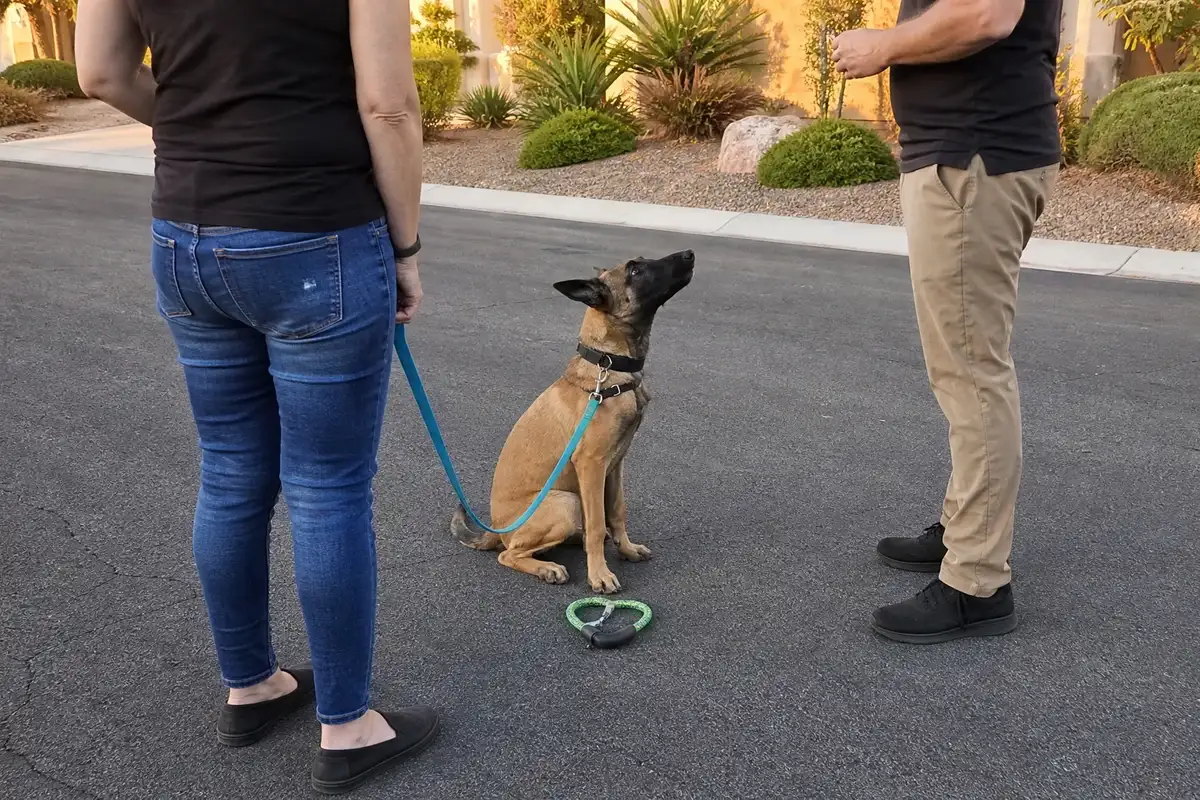
Local conditions change which type is practical. Summer pavement is the biggest one: Clark County says hot pavement can burn paw pads and recommends walking in the early morning or late evening (Clark County heat release). Group classes and park practice at midday in July are a poor idea, so ask any provider how they handle heat. Our own outdoor sessions run in cooler hours; the rest of the day we work indoors.
Location also matters for exposure. The city lists three dog parks at Craig Ranch Regional Park, open daily 6 a.m. to 11 p.m., and says outside designated dog parks, dogs must be leashed and kept off sports fields, courts, skate parks and play areas. We usually practice leash skills and calm observation near a park before we ever think about off-leash play there. See dog park behavior.
A common situation North Las Vegas owners face is signing a dog up for a group class, then finding it cannot focus because it is overheated or overwhelmed. Starting with a private or online session gives the dog skills first, so a later group class goes better.
Can you combine types, and does where you live matter?
Yes, and many owners do. A typical path is private work to build skills, then a group class for distraction practice, then off-leash or advanced training only when your dog is reliable on leash. Each step needs the one before, and you can pause at any step if your dog is not ready. There is no rule that says every dog must finish the whole path.
Housing is another factor: about 36% of North Las Vegas households rent (RentCafe, secondary Census-based source, last verified 2026-11-17), and renters often need quiet, calm routines more than advanced tricks. Our apartment dog guide covers that.
What should you know about off-leash and advanced training?
Off-leash and advanced work belong at the end of the path, not the start. Reliable off-leash behavior is built from recall practice on a long line, steady focus around distractions and a dog who chooses to stay near you. In North Las Vegas the leash rules also decide where practice can happen: the city says all pets must be leashed at all times unless confined on or within the owner's property, with fines listed up to $1,137 per offense (city Animal Protection page, last verified 2026-11-17). The city publishes no leash length on that page, so we do not state one. We therefore practice off-leash skills only in settings where they are allowed and safe, such as a designated dog park or a private fenced space.
Goal-based programs such as Canine Good Citizen and therapy dog preparation build on basic obedience. See off-leash training and Canine Good Citizen and therapy dog prep. Ask any provider, us included, to show how a dog moves from leash to long line to off-leash, and what happens if your dog does not respond.
- What does a typical session look like, start to finish?
- How many dogs or owners share a session or class?
- What practice is expected between sessions?
- How do you pause or adapt if my dog is stressed?
Frequently asked questions
Which type of dog training is best?
It depends on your dog and your goal. Private training suits behavior tied to your home, online coaching suits many puppies and manners, and group classes suit social dogs. We can help you choose between in-person and online.
Is online training as effective as in-person?
For many manners, puppy and mild problems, yes, when the owner practices consistently. For leash handling that needs hands-on help or any safety concern, in-person usually fits better.
Is board-and-train a good idea?
It can give a head start, but skills only last if you learn how to cue and reward at home. Ask for a written plan and daily schedule, and note that we could not verify a local price range.
Do group classes require vaccines?
We found no published local rule. Requirements are set by each provider, so ask the provider and your vet before you enroll.
Can I switch types later?
Yes. Many dogs start with private work and move to a group class once they can focus. Tell your trainer what is and is not working.
Keep reading
- Choose in-person or onlineRead more →
- private in-home trainingRead more →
- online dog trainingRead more →
- group dog training classesRead more →
- board-and-trainRead more →
- cost of dog trainingRead more →
Sources
- Purdue Canine Welfare Science Center, AVSAB humane dog training position statement (last verified 2026-11-17)
- AAHA, 2015 Canine and Feline Behavior Management Guidelines, take-home messages (last verified 2026-11-17)
- Clark County, pet heat safety news release (last verified 2026-11-17)
- City of North Las Vegas, Craig Ranch Regional Park (last verified 2026-11-17)
- RentCafe, North Las Vegas rental market (secondary, Census-based) (last verified 2026-11-17)
- City of North Las Vegas, Parks page (park rules) (last verified 2026-11-17)
- City of North Las Vegas, Animal Protection Services page (last verified 2026-11-17)
Compare in-person and online training for your dog before you choose
- In-person training in North Las Vegas and nearby areas
- Online training anywhere
- Reward-based methods only