
A certification tells you a trainer passed a particular exam or finished a particular program; it does not tell you how that trainer will treat your dog. We are trainers, so here is how we read the credentials you will meet around North Las Vegas, what Nevada law does and does not license, and what to ask any trainer, us included.
Want to know how we train before you commit? Choose in-person or online and we will talk methods first
- In-person training in North Las Vegas and nearby areas
- Online training anywhere
- Reward-based methods only
What do the common dog trainer credentials mean?
Each credential measures something different, and none of them guarantees good handling. This is how we explain the letters when owners ask; the table summarizes what the issuing organizations publish, read on 2026-11-17.
| Credential | What it is | What it does not tell you |
|---|---|---|
| CPDT-KA (CCPDT) | Exam covering ethology, learning theory, training technique and instruction, with 200 multiple-choice questions. Eligibility lists 300 hours of dog-training experience in the last 3 years. Recertify every 3 years by earning continuing education units or retaking the exam. | How the trainer behaves with your dog, or how well they coach owners |
| IAABC credentials (such as CDBC) | Earned by exam. The Certified Dog Behavior Consultant level is for complex cases, with about 3 years of experience and 400+ hours of education recommended, not hard requirements. | Whether a behavior consultant is the right fit for a simple manners goal |
| KPA CTP | A graduate of the Karen Pryor Academy Dog Trainer Professional Program who pledges force-free principles. | Hands-on experience with your particular problem |
Sources: CCPDT, IAABC and Karen Pryor Academy. We have not stated anything about our own credentials here, and you should ask any trainer to show you theirs.
Does a dog trainer need a license in Nevada?
We found no Nevada license for general pet obedience or behavior trainers, and we say only what we found. A state license does exist for "dog handlers": under NRS chapter 648, a license is required to engage in business as a dog handler, defined as handling, supplying or training dogs for protection or safety of persons or property. That is protection and security work. On its face it does not cover pet obedience training.
Two cautions. First, we read the statute on a public-law mirror, not the Legislature's own site, so check the current text at the statute page and on leg.state.nv.us. Second, we did not research North Las Vegas or Clark County business-license rules for trainers, so we cannot say whether a general business license applies.
The nearest local rule we verified is the Clark County animal handler course. The county says owners of pet-service businesses, including training, and employees with animal contact must complete it, and that it is required in unincorporated Clark County. Businesses also in North Las Vegas must comply with the city's requirements too. Ask any trainer what they hold and why.
The bottom line: because no state license separates good pet trainers from poor ones, the choice is yours, which is why methods and questions matter. See questions to ask before hiring a trainer.

Should you only hire a certified trainer?
A credential is useful evidence, but it is one piece. Some skilled trainers hold none, and a credential does not tell you whether the trainer uses humane tools or how a session runs.
The veterinary behavior bodies speak to methods directly. The American Veterinary Society of Animal Behavior (AVSAB), in a position statement hosted by Purdue, supports reward-based methods for all canine training and says there is no evidence aversive training is necessary. The AAHA 2015 behavior management guidelines oppose training methods that use aversive techniques. Ask what a trainer does when a dog gets it wrong, not only what letters they carry.
- Ask what tools they use, and why.
- Ask how they teach owners, not only dogs.
- Ask what happens if the approach is not working.
- Ask how they handle heat, fear and a dog who bites.
What local factors should shape your choice in North Las Vegas?
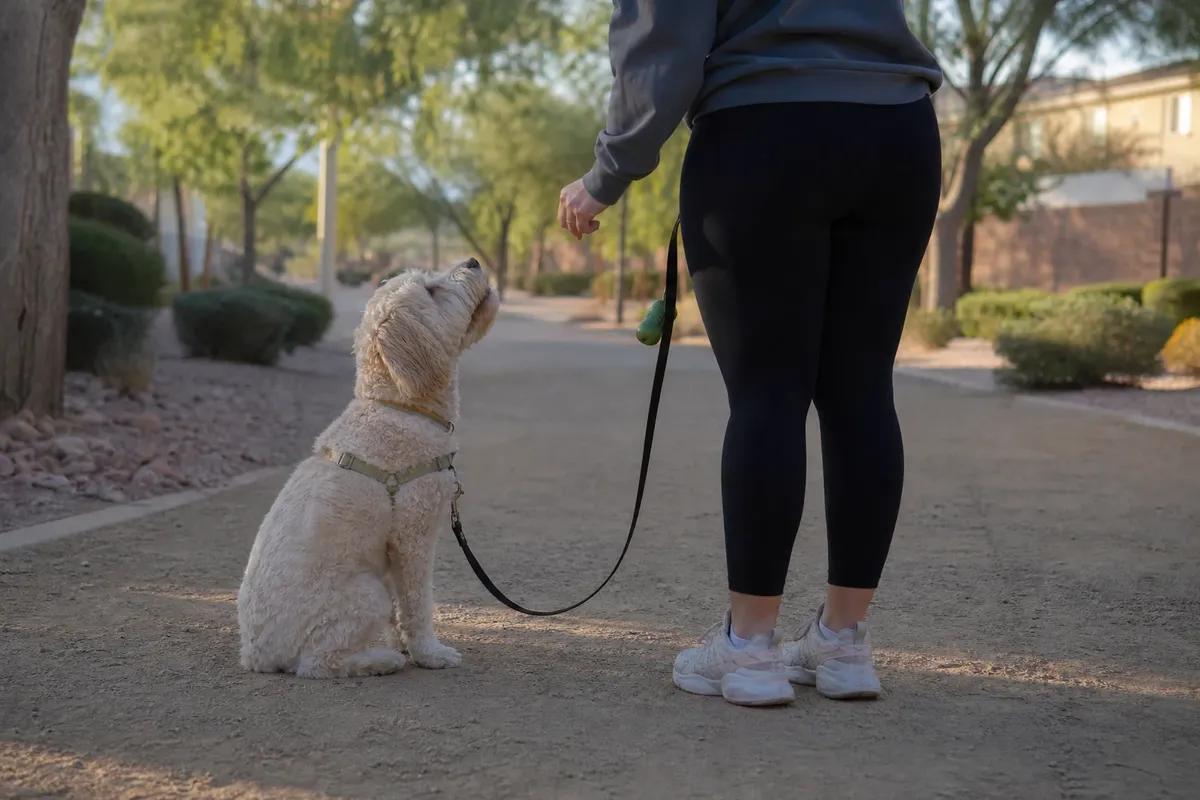
Pick a trainer who plans around the desert, not around a script. Clark County says pavement can be 40 to 60 degrees hotter than the air and urges walks in the cooler parts of the day, so a trainer who insists on noon outdoor sessions in July is ignoring the data.
A trainer should also know the local calendar. Fireworks around July 4 push shelter numbers up by hundreds in Clark County, according to the county, and a good plan covers noise fear before the holiday. A trainer working near washes should know the National Weather Service's July and August monsoon warning about flash flooding.
A common situation North Las Vegas owners face: an owner sees a rattlesnake-avoidance course advertised and asks whether it is worth it. The Nevada Department of Wildlife recommends looking into snake avoidance training; we also note that such programs often use electronic collars, which we do not use. We would prioritize management first: a 6-foot leash, no heads in holes, and a shaded yard checked before use.
How we train, and what you can expect from us
We use reward-based methods, management and prevention, gradual desensitization and counter-conditioning, short consistent sessions and owner coaching, with humane tools only. We make no promises about timelines, because progress depends on the dog and on how consistently the household practices.
- We explain what we are doing and why, so you can repeat it.
- We keep sessions short and stop on a good note.
- We tell you plainly if a vet visit or a behavior consultant would help more.
Ready to talk methods? Choose in-person or online on the start page. If your dog has a bite history, tell us when you choose a program.
Frequently asked questions
What is the difference between CPDT-KA and CDBC?
CPDT-KA, from CCPDT, is an exam on learning theory and training technique. The CDBC, from IAABC, is aimed at behavior consultants working complex cases such as fear and aggression.
Does Nevada license dog trainers?
We found a license for dog handlers who train protection or security dogs (NRS chapter 648) and no state license for pet obedience trainers. Check the statute text yourself.
Is a certification enough?
No. It shows a trainer passed an exam or program. Ask about methods, tools and how owners are coached.
Do you use shock, prong or choke collars?
No. We use humane tools only. AVSAB and AAHA both advise against aversive methods.
Does the Clark County handler course apply to trainers in North Las Vegas?
The county requires it in unincorporated Clark County and says businesses also in North Las Vegas must follow the city's requirements too. Ask the trainer what they hold.
Keep reading
- how to choose a dog trainer in North Las VegasRead more →
- training methods and red flagsRead more →
- questions to ask before hiring a trainerRead more →
- in-person dog trainingRead more →
- online dog trainingRead more →
- choose in-person or online trainingRead more →
Sources
- CCPDT, dog trainer certification (last verified 2026-11-17)
- IAABC, credentials (last verified 2026-11-17)
- Karen Pryor Academy, KPA CTP (last verified 2026-11-17)
- Purdue Canine Welfare Science Center, AVSAB humane dog training position statement (last verified 2026-11-17)
- AAHA, 2015 behavior management guidelines, take-home messages (last verified 2026-11-17)
- NRS 648.0065, dog handler definition (public.law mirror) (last verified 2026-11-17)
- Clark County, animal handler course (last verified 2026-11-17)
- Clark County, protecting pets in extreme heat (last verified 2026-11-17)
- Clark County, safe and sane fireworks (last verified 2026-11-17)
- Nevada Department of Wildlife, living with rattlesnakes (last verified 2026-11-17)
- National Weather Service Las Vegas, climate of Las Vegas (last verified 2026-11-17)
Want to know how we train before you commit? Choose in-person or online and we will talk methods first
- In-person training in North Las Vegas and nearby areas
- Online training anywhere
- Reward-based methods only